· David Okafor · Engineering · 8 min read
Quick-Turn PCB Pricing
Transparent breakdown of quick-turn PCB pricing premiums. Covers rush fees for 24hr, 48hr, and 5-day express service across 2-layer to 16-layer boards. Includes cost-per-day analysis and decision framework for when express manufacturing makes financial sense.
Quick Answer
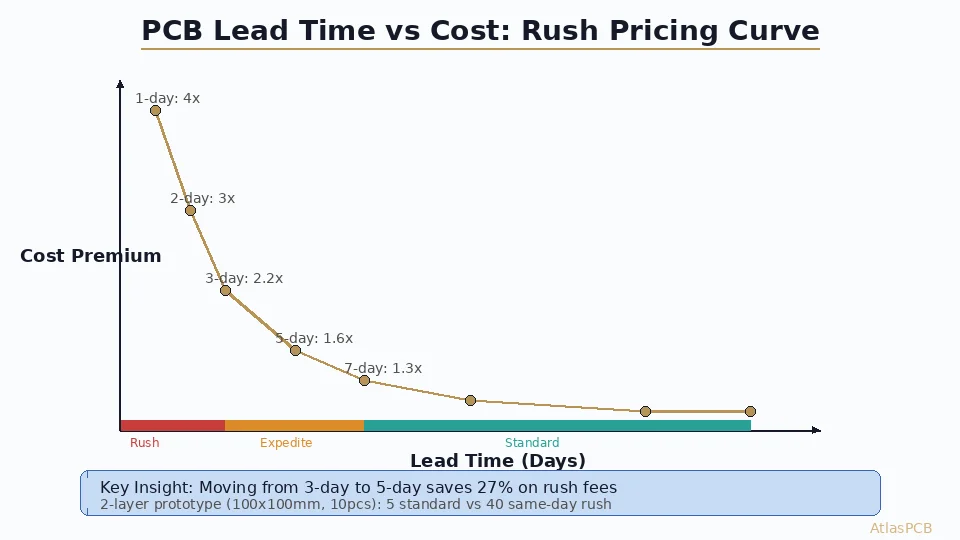
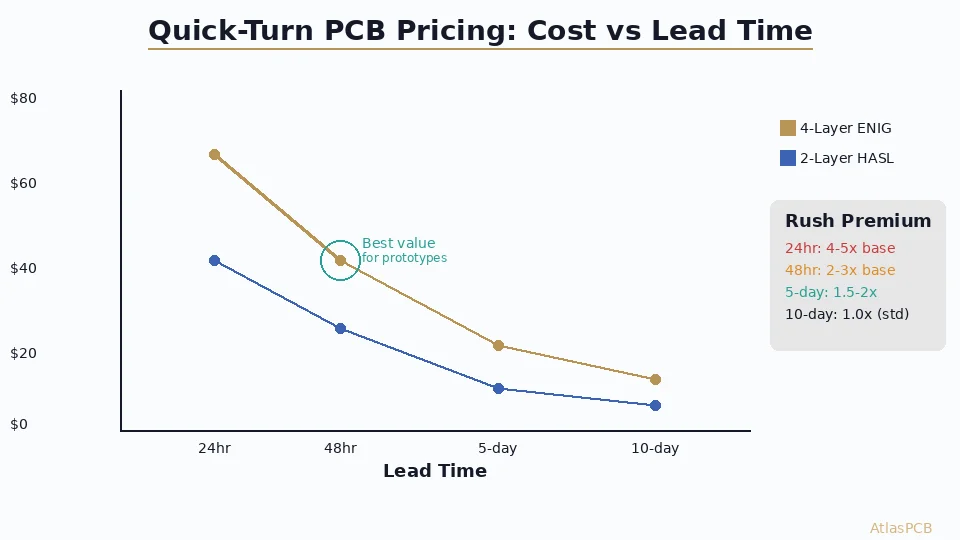
Quick-turn PCB manufacturing typically adds 30-200% to the base fabrication price depending on lead time and board complexity. A standard 4-layer 1.6mm board (100x100mm, 10 pcs) costs approximately $8-12/board at 10-day lead time, $12-18 at 5-day, $20-30 at 48-hour, and $35-55 at 24-hour express. The premium is not purely profit margin — it reflects actual production disruption costs, overtime labor, dedicated equipment allocation, and yield risk from accelerated process steps. Express manufacturing makes financial sense when: (1) the delay cost exceeds the rush premium (engineer idle time, missed market window), (2) the board revision is blocking downstream assembly, or (3) you need functional validation to prevent a larger production run mistake.
The Real Cost of Speed: Quick-Turn Pricing Decoded
| Board Type | Standard (10-12 day) | 5-Day Express | 48-Hour | 24-Hour |
|---|---|---|---|---|
| 2L, 1.6mm, 1oz, HASL | $4-7/pc | $7-12/pc | $18-30/pc | $30-50/pc |
| 4L, 1.6mm, 1oz, ENIG | $10-15/pc | $16-25/pc | $30-50/pc | $50-80/pc |
| 6L, 2.0mm, 1oz, ENIG | $18-28/pc | $30-45/pc | $55-85/pc | Not available |
| 8L, 2.0mm, impedance ctrl | $30-45/pc | $48-70/pc | $80-130/pc | Not available |
| 10-16L, HDI 1+N+1 | $50-90/pc | $80-140/pc | Not standard | Not available |
Note: Prices assume 100x100mm board size, 5-10 piece quantity, standard FR-4 material. Larger boards, tighter tolerances, or special materials add to the base price before the rush multiplier.
What Drives the Express Premium (It Is Not Just Markup)
When a fabricator quotes 3x the standard price for 48-hour service, most engineers assume this is opportunistic pricing. The reality is more nuanced, and understanding the actual cost structure helps you negotiate better and make informed purchasing decisions.
Standard PCB fabrication operates on a batch production model. Your boards share panel space with other orders of similar specification, and each process step (imaging, etching, drilling, plating) runs in scheduled batches optimized for equipment utilization. A panel might sit in queue for 4-8 hours waiting for the next etch cycle that matches its copper specification, or wait overnight for the plating line to finish the current batch.
Express manufacturing breaks this model entirely. Your panel jumps the queue at every process station, displacing other work and creating inefficiency in the production flow. The drilling machine gets loaded with your panel mid-shift, even if it means dismounting another job. The imaging room exposes your panels immediately rather than accumulating a batch of matching orders. The plating line runs a shorter cycle with fewer panels, wasting chemistry and electroplating time.
These disruptions have real costs: overtime labor for dedicated operators, reduced yield from compressed process windows, chemistry waste from short plating runs, and opportunity cost from displaced standard orders that now slip their delivery dates. A rough breakdown of the express premium allocation looks like this:
| Cost Driver | Contribution to Premium |
|---|---|
| Queue displacement / scheduling | 30-40% |
| Overtime / dedicated labor | 20-25% |
| Reduced batch efficiency | 15-20% |
| Yield risk (accelerated processes) | 10-15% |
| Profit margin on rush | 10-15% |
This explains why the premium is not linear with speed — going from 5-day to 48-hour is a much larger relative premium than going from 12-day to 5-day. The 5-day option often simply means prioritizing your order within the standard production flow, while 48-hour requires fundamentally restructuring production around your single job.
TRANSPARENT PRICING
See Express Pricing Before You Commit
AtlasPCB shows you standard and express pricing side-by-side in your quote. No hidden rush fees — choose your lead time with full cost visibility.
Get Instant Quote ›
The Cost-Per-Day Decision Framework
The financially rational approach to lead time selection is simple: compare the express premium to the cost of the delay. If the delay costs more than the premium, pay for speed. If not, wait.
Calculate your delay cost:
For a hardware engineer earning $120-180K/year (loaded cost), that translates to approximately $80-120/hour or $640-960/day. If waiting for boards blocks productive work, each day of delay costs the company $640-960 in that engineer’s utilization alone.
For a program with a market window (product launch, trade show demo, customer deliverable), the delay cost is even higher — potentially thousands per day in lost revenue opportunity or contractual penalties.
Worked examples:
Scenario A — Prototype iteration: Your 4-layer board costs $12/pc standard (10 pieces = $120) or $25/pc express 48-hour (10 pieces = $250). The premium is $130. If the engineer is blocked for 8 additional days waiting, that is $5,000-7,000 in lost productivity. Express is obviously correct — you are paying $130 to avoid $5,000+ in delay cost.
Scenario B — Non-critical revision: You have a PCB revision that improves power supply decoupling but the current board is functional. Nothing is blocked. Standard delivery saves $130 and costs nothing in delay because the engineer continues other tasks. Standard is correct.
Scenario C — Pre-production validation: You need 50 boards for environmental testing before committing to a 5,000-piece production run. The 50 boards cost $2,200 standard or $3,800 at 5-day express. The premium is $1,600. If the 5-day savings allows you to start production 7 days earlier, and production revenue is $50K/day, the express premium is negligible compared to the revenue acceleration.
The key insight: quick-turn pricing only seems expensive when you look at the PCB cost in isolation. When you factor in the system-level cost of delay, express fabrication is almost always the right choice for critical-path prototypes.
What You Can and Cannot Rush
Not all PCB features are compatible with accelerated timelines. Understanding these constraints helps you plan which revisions need rush service and which features to defer.
Available at 24-48 hours (most fabricators):
- 2-4 layer boards (6L at some shops)
- Standard FR-4, 1.6mm thickness
- HASL or ENIG surface finish
- Mechanical drilling down to 0.2mm
- Standard trace/space (4/4 mil and above)
- Board size up to 200x300mm
- Solder mask both sides (green standard)
Available at 5-day express:
- Up to 10-12 layers
- Controlled impedance (+/-10%)
- ENIG, immersion silver, OSP finishes
- 3/3 mil trace/space
- Carbon, peelable mask
- Board size up to 400x500mm
- Non-standard thickness (0.8mm, 2.0mm, 2.4mm)
Requires standard lead time (8-18 days):
- HDI with sequential lamination
- Rigid-flex construction
- Rogers, PTFE, polyimide materials (procurement time)
- Heavy copper (3oz+)
- Backdrilling with tight tolerances
- Boards exceeding 16 layers
- Embedded components, embedded resistors
The common mistake is assuming you can rush a complex board to the same timeline as a simple one. If your prototype requires HDI microvias, no fabricator will deliver in 48 hours regardless of price. Plan accordingly by separating your hardware development into simple test vehicles (rushable) and full-featured builds (standard timeline).
FAST TURNAROUND
2-Layer Boards Ship in 24 Hours
Standard 2-layer and 4-layer prototypes with 24-hour, 48-hour, and 5-day express options. Upload now, boards ship tomorrow.
Upload Gerber ›How to Minimize Express Costs Without Slowing Down
Even when express is justified, you can reduce the premium through design choices and ordering strategy:
1. Design for rushability. Keep your prototype as simple as possible for the specific validation you need. If you are testing firmware, a 2-layer board with wide traces is fine — save the impedance-controlled 8-layer for the next revision. Each reduction in complexity drops you to a faster/cheaper express tier.
2. Consolidate revisions. Rather than rushing three separate 2-day revisions over two weeks, invest more time in simulation and review to get a single revision right. One 48-hour express run at $250 beats three runs at $750 total.
3. Use assembly-free test boards when possible. If you only need to verify a PCB feature (impedance, thermal via performance, connector footprint), order bare boards without assembly. Bare board express is 2-3x faster and cheaper than assembled express.
4. Build standard-timeline inventory in parallel. For boards you know you will need multiple times (development test fixtures, debugger adapters), order standard delivery as a background task while rushing only your critical prototype.
5. Negotiate volume commitments. If you anticipate multiple rush orders over a project, discuss a blanket express rate with your fabricator. Many shops offer 10-20% reduced rush premiums for committed repeat customers.
Quality at Speed: Does Express Manufacturing Affect Board Quality?
This is the question every quality engineer asks, and the honest answer is: properly managed express production should produce identical quality to standard production. The IPC acceptance criteria (IPC-6012E for rigid boards) do not change based on lead time — a Class 2 board must meet Class 2 regardless of how quickly it was made.
However, there are real risk factors to monitor. Accelerated etch times increase the probability of under-etching or over-etching at trace edges. Compressed plating cycles may produce slightly more thickness variation across the panel. Reduced time for solder mask cure can occasionally cause adhesion issues in humidity.
Reputable fabricators mitigate these risks through in-process inspection at every critical step, regardless of timeline. The key differentiator is not whether they can make the board fast — it is whether they maintain their inspection gates at speed. Ask your fabricator specifically: “Do you skip any inspection steps on express orders?” The correct answer is no.
At AtlasPCB, express orders follow identical inspection and testing protocols as standard production. The speed comes from prioritized scheduling, not from cutting process corners.
ATLASPCB
Same Quality, Different Speed. Choose Your Timeline.
Every AtlasPCB quote shows standard and express options with clear pricing. Pick the lead time that matches your project schedule. No quality compromise at any speed.
Get Instant Quote ›
Related Reading:
About AtlasPCB — We specialize in complex PCB manufacturing for HDI, RF, and high-reliability applications. Explore our PCB prototype manufacturing from 1 piece, quick-turn PCB manufacturing from 24 hours, or get an instant online PCB quote . Every order includes free engineering review. Get your quote.
Reviewed by AtlasPCB Engineering Team — IPC-certified manufacturing specialists with 15+ years of production experience in HDI, RF, and high-reliability PCB fabrication. Content based on factory floor data and real customer design reviews.
Frequently Asked Questions
How much does 24-hour PCB fabrication cost?
Is 48-hour PCB service the best value for prototypes?
What PCB features are NOT available at express lead times?
Should I pay for quick-turn or fix my schedule?
- PCB pricing
- quick-turn PCB
- express PCB
- prototype cost
- PCB lead time
- rush manufacturing
- PCB quote