· Thomas Webb · News · 7 min read
CCL and FR-4 Laminate Prices Rising in Q3 2026
FR-4 and CCL suppliers are signaling Q3 2026 price adjustments as resin costs remain volatile, glass fiber tightens on high-Tg grades, and AI server demand concentrates capacity at the high end. Here is what this means for your multilayer PCB orders and how to protect your project timeline.
Quick Answer
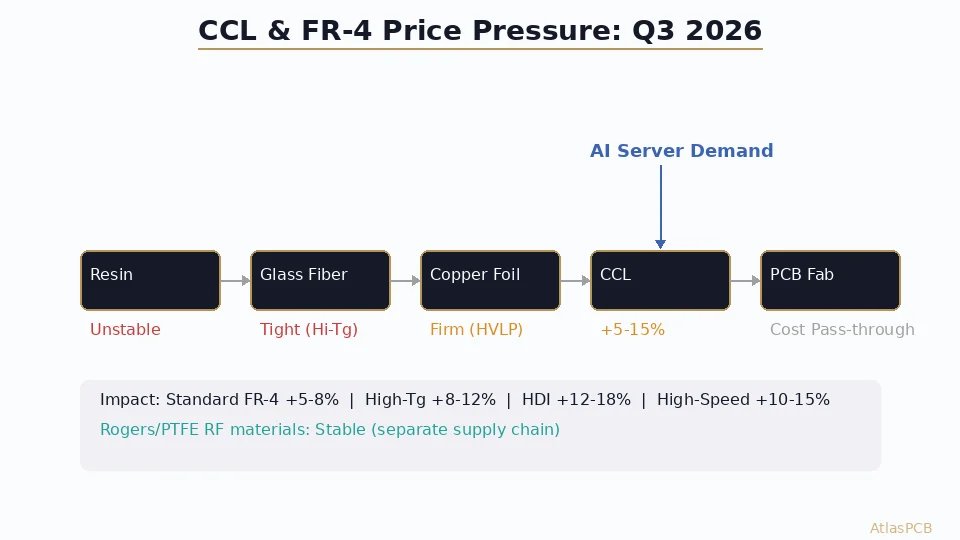
Multiple CCL (copper-clad laminate) suppliers are signaling July 2026 price adjustments for FR-4 and high-speed materials. The drivers include unstable resin costs, tight glass fiber supply for high-Tg grades, firming copper prices with HVLP foil shortages, and AI server demand concentrating capacity at the premium end. Standard FR-4 boards face 5-10% material cost increases; high-layer-count and HDI boards may see 10-20% impact.
What Is Happening: July 2026 Material Pricing Signals
As of late June 2026, multiple CCL (copper-clad laminate) suppliers across Asia have begun signaling price adjustments effective July. This is not a single dramatic jump, but rather a convergence of several raw material pressures that are shortening quote validity windows and reducing pricing flexibility across the PCB supply chain.
The pattern is now clear enough to warrant attention from any engineering team planning PCB fabrication orders for Q3-Q4 2026.
The Three Drivers Behind Q3 Price Movement
Resin Cost Instability
Epoxy resin — the primary binding material in FR-4 laminate — has not stabilized after Q2 fluctuations. While not spiking dramatically, prices remain elevated at levels that prevent CCL manufacturers from absorbing costs without passing increases downstream. The unpredictability is arguably worse than a clean price jump: suppliers are shortening quote validity periods from 30 days to 14-21 days, making procurement planning more difficult.
Glass Fiber Fabric Tightness on High-Tg Grades
Standard E-glass for basic FR-4 remains adequately supplied. However, high-Tg grades — the glass fiber weaves used in lead-free-compatible laminates (Tg170+) and high-speed materials — are experiencing allocation constraints. This disproportionately affects boards designed for automotive, aerospace, and data center applications where lead-free assembly temperatures mandate high-Tg substrates.
In our production scheduling over the past two weeks, we have seen lead time extensions of 3-5 days specifically for Shengyi S1170 and ITEQ IT-180A materials that were previously available from stock.
AI Server Demand Concentrating Premium Capacity
The ongoing AI infrastructure buildout continues to absorb disproportionate amounts of high-end PCB fabrication capacity. Boards for AI server applications — typically 16-30 layers with low-loss materials, HVLP copper, and tight impedance control — are consuming both the premium materials and the advanced manufacturing lines.
This creates a cascade effect: when high-end capacity is fully booked, some mid-complexity orders that would normally run on advanced lines get pushed to standard lines, creating bottlenecks in what was previously “comfortable” capacity.
PRICE PROTECTION
Lock In Q2 Pricing Before July Increases
Submit your production orders now to secure current material pricing. We honor quoted prices for 30 days and offer 60-day material locks for confirmed volume orders.
Get Quote at Current Pricing ›
Copper Side: Quiet but Firm
Copper has not made headlines, but it remains firm at elevated levels. More critically for PCB manufacturing, specific copper foil specifications are becoming harder to source promptly:
- Ultra-thin foils (12μm and below): Required for fine-line HDI routing, lead times have extended by 1-2 weeks
- HVLP (hyper-very-low-profile) foils: Essential for high-speed digital boards where surface roughness affects insertion loss — these are heavily allocated to AI server programs
- Standard 1oz (35μm) electrodeposited foil: Remains adequately supplied with normal lead times
The copper foil situation affects HDI and high-speed designs more than standard multilayer boards. If your design requires HVLP foil for signal integrity reasons, factor in the extended material sourcing timeline.
What This Means for Different Board Types
| Board Type | Material Cost Impact | Lead Time Impact | Action Required |
|---|---|---|---|
| Standard 4-6L FR-4 (Tg150) | +5-8% | Minimal | Monitor, no urgent action |
| High-Tg FR-4 (Tg170+), 6-10L | +8-12% | +3-5 days | Consider placing orders now |
| HDI (1+N+1 or higher) | +12-18% | +5-7 days | Lock material with confirmed PO |
| High-speed digital (Megtron/I-Speed) | +10-15% | +5-10 days | Lock material immediately |
| 16+ layer AI/HPC boards | +15-20% | +7-14 days | Negotiate volume material lock |
| Rogers/PTFE RF boards | Stable | Stable | No change needed |
How We Are Managing This for Current Customers
Our approach to the Q3 material environment:
Material flexibility with engineering review. When a specified material faces supply constraints, our engineering team evaluates drop-in alternatives that maintain electrical performance. For example, when Shengyi S1170 is on allocation, ITEQ IT-180A provides equivalent Tg and Dk/Df performance with potentially shorter lead time. We make this substitution recommendation with full data — never silently.
Multi-supplier qualification. We maintain qualified material sources across Shengyi, ITEQ, and Nan Ya for standard FR-4 through high-Tg grades. This means when one supplier is constrained, we can shift to an alternative without re-qualifying the process — reducing the supply disruption impact.
Volume commitment pricing. For customers with confirmed Q3-Q4 production schedules, we offer material cost locks at current pricing for 60-90 days against a confirmed purchase order. This protects against interim price adjustments while materials are on order.
MULTI-SOURCE ADVANTAGE
Material Flexibility Without Performance Compromise
Our engineering team evaluates material alternatives when primary sources face constraints. Qualified substitutes across 3 major CCL suppliers ensure your orders ship on time.
View Our Material Capabilities ›Actionable Recommendations for Q3 Planning
For prototype orders (under 50 pieces): Material cost is a small fraction of prototype pricing (typically 15-20% of total). Price impact will be minimal — likely $2-8 per board for a standard 8-layer design. Continue ordering as normal.
For pre-production (50-500 pieces): Consider ordering earlier than planned if your design is finalized. A 5-10% material increase on 200 boards at $15 each means $150-300 additional cost — not catastrophic, but avoidable.
For production volumes (500+ pieces): This is where material price increases compound meaningfully. A 10% increase on 1000 boards at $8/board means $800 additional spend. Lock pricing now with a confirmed PO if your production schedule permits.
For AI/HPC programs: If your design requires HVLP copper and high-speed laminates, add 2-3 weeks to your material sourcing timeline. Discuss material alternatives with your fabricator — in some cases, a slightly different laminate system achieves equivalent electrical performance with better current availability.
ENGINEERING REVIEW
Need Material Alternatives? Our Engineers Can Help
Share your stackup requirements and we will identify cost-effective material options that maintain your electrical performance targets while avoiding supply constraints.
Discuss Material Options ›The Bigger Picture: Structural Shift, Not Temporary Spike
This is not a one-month anomaly. The AI-driven demand concentration at the high end of PCB manufacturing is a structural shift that will persist through 2026 and likely into 2027. As hyperscalers continue building GPU clusters and custom ASIC programs accelerate, the demand for high-layer-count, low-loss, tight-tolerance PCBs will keep premium capacity under pressure.
For most hardware teams building products below the AI/HPC tier, the practical implication is modest but consistent upward pressure on material costs — punctuated by occasional supply tightening on specific grades. The best hedge is supply chain flexibility: work with manufacturers who qualify multiple material sources and can shift between suppliers without sacrificing quality or requiring design changes.
ATLASPCB
Secure Your Q3 Production Pricing Today
Get a quote locked at current material pricing. Volume orders qualify for 60-day price protection with confirmed PO. Multi-supplier qualification means your orders ship even when primary sources are constrained.
Get Protected Quote ›
Reviewed by AtlasPCB Engineering Team — 15+ years in advanced PCB fabrication for RF, HDI, and rigid-flex applications.
Related Reading:
About AtlasPCB — We specialize in complex PCB manufacturing for HDI, RF, and high-reliability applications. Explore our HDI PCB manufacturing capabilities, multilayer PCB fabrication up to 30 layers, or get an instant online PCB quote . Every order includes free engineering review. Get your quote.
Reviewed by AtlasPCB Engineering Team — IPC-certified manufacturing specialists with 15+ years of production experience in HDI, RF, and high-reliability PCB fabrication. Content based on factory floor data and real customer design reviews.
Frequently Asked Questions
How much will PCB prices increase in Q3 2026?
Why are FR-4 prices going up now?
Should I lock in PCB pricing now before Q3 increases?
Which PCB materials are most affected by the Q3 price increase?
- multilayer PCB cost
- PCB pricing
- CCL shortage
- FR-4 laminate
- HDI PCB manufacturer