· Marcus Lin · Engineering · 5 min read
Immersion Silver vs ENIG for High-Speed PCB
A direct comparison of Immersion Silver and ENIG surface finishes for high-speed digital applications. Covers signal loss, solderability, shelf life, cost, and when each finish is the right engineering choice.
Quick Answer
Immersion Silver delivers lower insertion loss and flatter coplanarity than ENIG at high-speed frequencies above 10 GHz, but ENIG wins on shelf life and multiple reflow tolerance. Choose Immersion Silver for loss-sensitive 25+ Gbps links; choose ENIG when boards face extended storage or harsh assembly profiles.
Quick Answer: Immersion Silver vs ENIG for High-Speed PCB
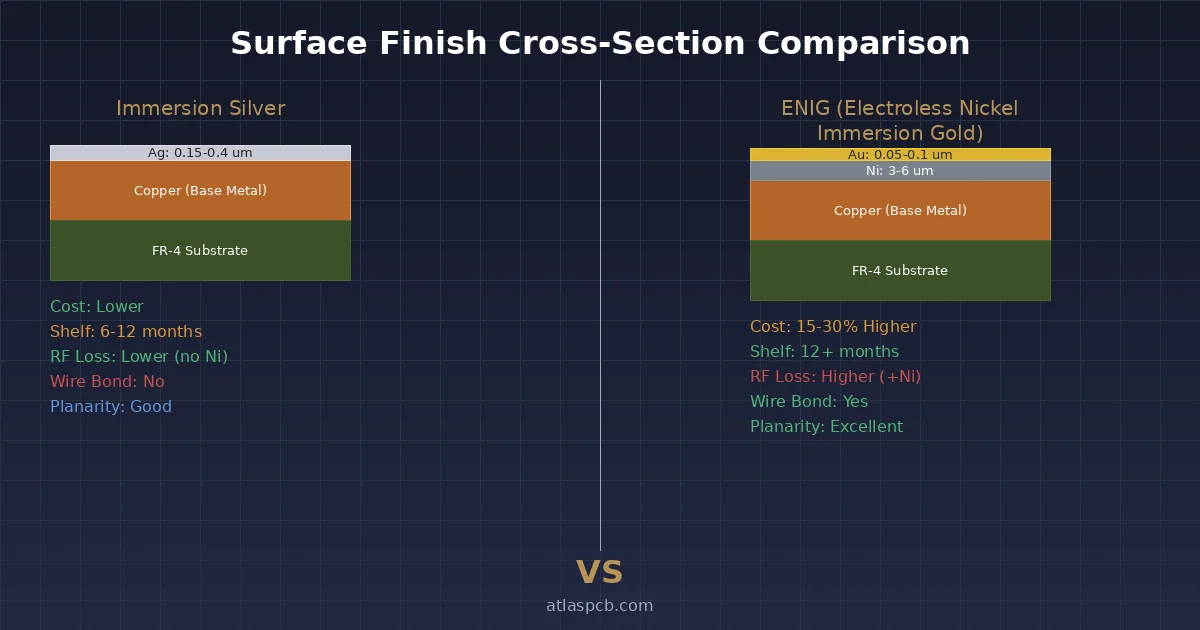
| Parameter | Immersion Silver | ENIG |
|---|---|---|
| Insertion loss (25 GHz) | 0.8-1.0 dB/in | 1.1-1.4 dB/in |
| Coplanarity | Excellent (flat) | Good (Ni stress possible) |
| Shelf life | 6-12 months (sealed) | 12+ months |
| Reflow tolerance | 2-3 cycles | 4-6 cycles |
| Wire bonding | No | Yes (Au surface) |
| Cost (relative) | 1.0x | 1.4-1.6x |
| Corrosion risk | Tarnish if exposed | Black pad syndrome |
Decision shortcut: If your design has 25+ Gbps SerDes links and controlled inventory logistics, Immersion Silver wins on electrical performance. If you need long shelf life, wire bonding pads, or 4+ reflow cycles, ENIG is safer.
Why Surface Finish Matters at High Frequencies
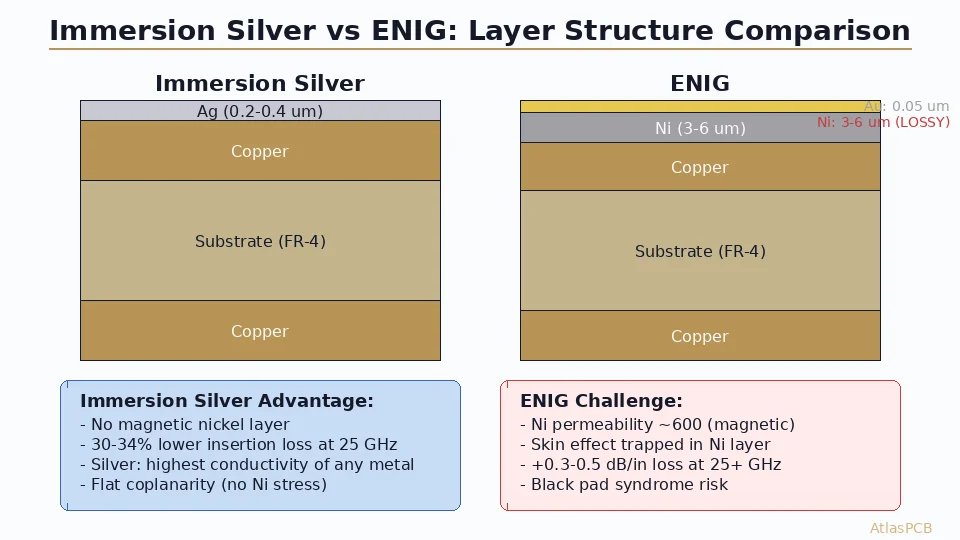
At frequencies above 5 GHz, signal current concentrates in the top 1-3 micrometers of conductor surface due to skin effect. Your surface finish IS your signal conductor at these frequencies.
ENIG places a 3-6 micrometer nickel layer between copper and gold. Nickel has a permeability of ~600 (vs. 1 for copper, silver, gold), which dramatically increases skin-effect loss. The 0.05-0.1 micrometer gold layer is too thin to shield signals from the nickel beneath.
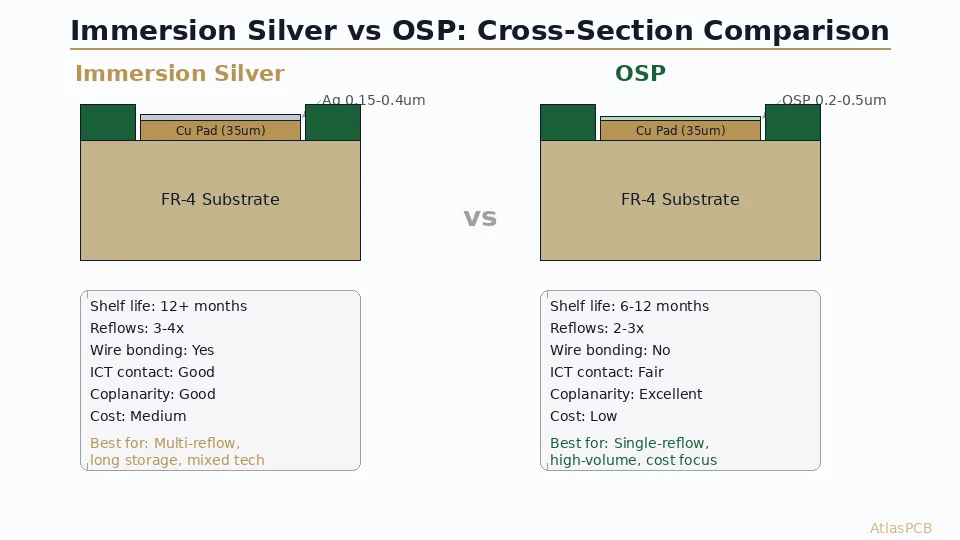
Immersion Silver deposits 0.15-0.4 micrometer of pure silver directly on copper. Silver has the highest conductivity of any element (1.05x copper), creating the lowest-loss surface possible.
HIGH-SPEED PCB EXPERTISE
Need Help Choosing the Right Surface Finish?
Our engineers review your stackup, data rates, and assembly requirements to recommend the optimal finish for your application.
Get Recommendation ›
Insertion Loss Comparison: The Numbers
Testing data from multiple independent labs confirms the performance gap:
| Frequency | Immersion Silver Loss | ENIG Loss | Delta |
|---|---|---|---|
| 5 GHz | 0.35 dB/in | 0.42 dB/in | +20% |
| 10 GHz | 0.52 dB/in | 0.68 dB/in | +31% |
| 25 GHz | 0.88 dB/in | 1.18 dB/in | +34% |
| 56 GHz | 1.45 dB/in | 1.92 dB/in | +32% |
At 112 Gbps PAM-4 signaling (28 GHz fundamental), a typical 6-inch trace sees approximately 1.8 dB additional loss with ENIG versus Immersion Silver. That 1.8 dB can be the difference between meeting and failing eye diagram margins.
Real-World Impact
For PCIe Gen6 (64 GT/s, PAM-4) and 800G Ethernet designs:
- Channel loss budgets are typically 28-32 dB
- 1.8 dB represents 6-7% of your total budget consumed by surface finish alone
- With tight margins, this can eliminate the need for a signal retimer
Assembly and Manufacturing Considerations
Solderability
Both finishes provide excellent solderability when fresh:
- Immersion Silver: Wetting force >1.5 mN within 2 seconds. Silver dissolves rapidly into solder, creating clean metallurgical bonds.
- ENIG: Wetting force >1.2 mN. Gold dissolves into solder; nickel provides the actual intermetallic (Ni3Sn4).
Failure Modes
Immersion Silver risks:
- Micro-voiding at via-in-pad interfaces (mitigated by process control)
- Tarnish/sulfidation in uncontrolled environments
- Creep corrosion in high-sulfur industrial environments
ENIG risks:
- Black pad syndrome (hyper-corrosion of nickel during gold deposition)
- Brittle fracture at Ni3Sn4 intermetallic under drop/vibration
- Higher CTE mismatch stress at BGA interfaces
SURFACE FINISH OPTIONS
We Process Both Finishes In-House
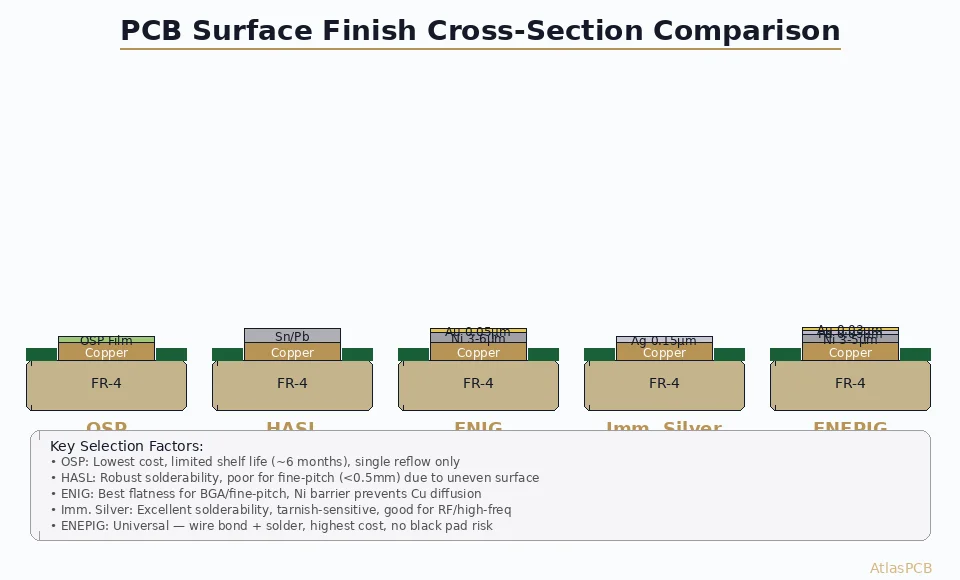
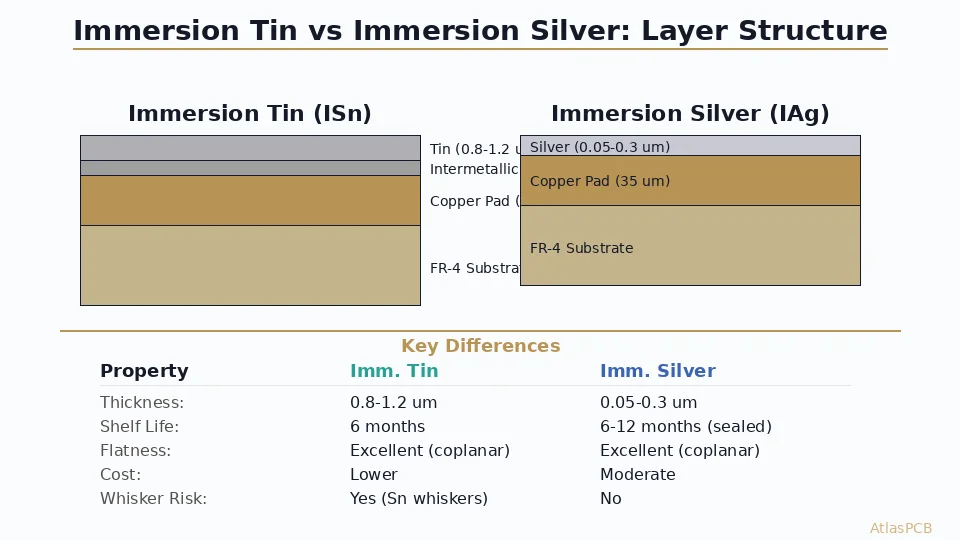
AtlasPCB offers ENIG, Immersion Silver, OSP, HASL, Immersion Tin, and Hard Gold — all under one roof with consistent process control.
View Capabilities ›Application Decision Matrix
| Application | Recommended Finish | Reason |
|---|---|---|
| 25G+ SerDes (PCIe 6, 800GbE) | Immersion Silver | Loss budget critical |
| DDR5/DDR6 memory | Either (both work) | Moderate frequency, margin exists |
| RF/microwave (>6 GHz) | Immersion Silver | Nickel magnetic loss unacceptable |
| BGA with wire bond | ENIG | Gold surface required |
| Automotive (long storage) | ENIG | 12+ month warehouse life |
| High-volume consumer | Immersion Silver | Cost advantage + JIT supply |
| Mixed-technology (SMT + TH) | ENIG | Multiple reflow + wave tolerance |
| Aerospace/mil-spec | ENIG or Hard Gold | Long-term reliability mandated |
Selective Surface Finish: The Best of Both Worlds
For designs with both high-speed signal pads and wire-bond or long-storage requirements, AtlasPCB offers selective surface finish — applying Immersion Silver to high-speed signal areas and ENIG to assembly or wire-bond areas on the same board.
SELECTIVE FINISH CAPABILITY
Combine Finishes on One Board
Immersion Silver for high-speed lanes, ENIG for BGA/wire-bond pads. One PCB, optimal performance everywhere.
Upload Gerber ›Standards and Specifications
| Standard | Immersion Silver | ENIG |
|---|---|---|
| IPC-4553A | Type 1 (0.15-0.4 μm Ag) | N/A |
| IPC-4552B | N/A | Type 1 (3-6 μm Ni, 0.05-0.1 μm Au) |
| J-STD-003 | Solderability pass | Solderability pass |
| Shelf life (IPC) | 6 months (Class 2), 12 months (sealed) | 12 months (Class 2) |
Decision Summary
- Start with your data rate — above 25 Gbps NRZ or 50 Gbps PAM-4, Immersion Silver gives measurable margin
- Check your logistics — if boards sit in warehouse >6 months, ENIG is safer
- Count your reflows — 4+ reflow cycles favor ENIG
- Consider selective — mixed requirements solved with dual-finish processing
ATLASPCB
Ready to Order High-Speed Boards?
Upload your design and specify your surface finish requirements. Our engineers verify compatibility with your BOM and assembly process.
Get Instant Quote ›
Related Reading:
About AtlasPCB — We specialize in complex PCB manufacturing for HDI, RF, and high-reliability applications. Explore our RF and high-frequency PCB services, impedance-controlled PCB manufacturing, or get an Megtron 6 & 7 low-loss PCB manufacturing . Every order includes free engineering review. Get your quote.
Reviewed by AtlasPCB Engineering Team — IPC-certified manufacturing specialists with 15+ years of production experience in HDI, RF, and high-reliability PCB fabrication. Content based on factory floor data and real customer design reviews.
Frequently Asked Questions
Is Immersion Silver better than ENIG for signal integrity?
How long does Immersion Silver last in storage?
Can Immersion Silver handle multiple reflow cycles?
What is the cost difference between Immersion Silver and ENIG?
- pcb surface finish
- immersion silver
- ENIG
- high-speed PCB
- signal integrity