· Marcus Lin · News · 9 min read
New Low-Loss PCB Laminates for 5G mmWave
The latest generation of ultra-low-loss laminates from Panasonic and AGC is redefining what's possible for 5G mmWave and 77GHz automotive radar PCBs, with dissipation factors breaking the 0.001 barrier.
The race to deliver ultra-low-loss PCB laminates for 5G millimeter-wave (mmWave) and automotive radar applications has reached a new milestone. Panasonic’s upcoming Megtron 7 and AGC’s latest hydrocarbon-based material upgrades are pushing dissipation factors (Df) below 0.001 at frequencies relevant to 5G FR2 and 77GHz automotive radar — a threshold that was considered achievable only with PTFE-based materials just a few years ago.
For RF and high-speed PCB designers, these developments represent a fundamental shift in the cost-performance equation for mmWave circuit boards. The new materials promise Rogers-like electrical performance with standard FR-4-like processability, potentially reshaping sourcing strategies for some of the industry’s most demanding applications.
The Low-Loss Imperative at mmWave Frequencies
Signal loss in a PCB increases dramatically with frequency. At the 28GHz and 39GHz bands used for 5G FR2 deployments, and especially at 77GHz for automotive radar, the dielectric loss of the laminate material becomes the dominant contributor to total insertion loss.
The relationship is straightforward: dielectric loss is proportional to frequency × Df. A material with a Df of 0.004 (typical mid-tier low-loss laminate) generates roughly four times the dielectric loss of a material with Df of 0.001 at any given frequency. At 77GHz, this difference translates to several dB of additional loss per inch of trace length — enough to make or break a radar module’s detection range.
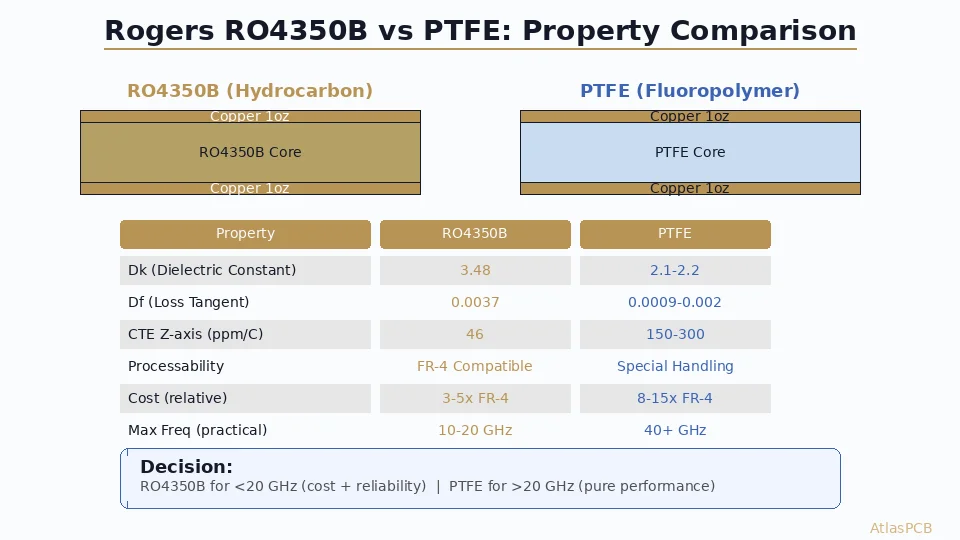
This is why material selection for mmWave applications has historically been dominated by PTFE-based laminates from Rogers Corporation (RO3003, RO4835, RT/duroid series) and ceramic-filled hydrocarbon blends. These materials offer Df values in the 0.001-0.002 range at 10GHz and maintain excellent performance at higher frequencies.
However, PTFE-based laminates come with significant manufacturing challenges:
- Specialized processing — PTFE requires sodium etching or plasma treatment for adhesion, different drill parameters, and modified lamination profiles
- Higher material cost — typically 5-15x the cost of standard FR-4 and 2-5x the cost of mid-tier low-loss laminates
- Limited multilayer capability — complex multilayer stackups with PTFE are difficult and expensive
- Longer lead times — smaller production volumes mean less predictable material availability
The industry has long sought non-PTFE alternatives that approach PTFE-level electrical performance while maintaining conventional processing compatibility. Panasonic’s Megtron series and AGC’s thermosetting resin-based materials have been at the forefront of this effort.
Megtron 7: Panasonic’s Next-Generation Ultra-Low-Loss Laminate
Panasonic’s Megtron series has been the industry standard for high-speed digital and RF applications that need better performance than standard FR-4 but can’t justify the cost and complexity of PTFE. The progression from Megtron 4 through Megtron 6 has tracked the industry’s escalating frequency requirements:
| Property | Megtron 4 (R-5575) | Megtron 6 (R-5775) | Megtron 7 (Announced) |
|---|---|---|---|
| Dk @ 10GHz | 3.8 | 3.4 | 3.1 |
| Df @ 10GHz | 0.005 | 0.002 | 0.0008 |
| Dk @ 28GHz | ~3.7 | ~3.3 | ~3.05 |
| Df @ 28GHz | ~0.006 | ~0.003 | ~0.001 |
| Df @ 77GHz | — | ~0.004 | ~0.0015 |
| Tg (°C) | 210 | 215 | 220 |
| CTE z-axis (ppm/°C) | 45 | 32 | 28 |
| Standard processing | Yes | Yes | Yes |
Note: Megtron 7 specifications are based on preliminary announced data and may be subject to revision at commercial launch.
The headline numbers for Megtron 7 are remarkable. A Df of 0.0008 at 10GHz places it firmly in PTFE territory, while maintaining the thermosetting resin chemistry that allows processing on standard multilayer PCB manufacturing lines without the specialized handling that PTFE demands.
At 28GHz — the primary band for 5G FR2 base station antennas and fixed wireless access equipment — Megtron 7’s projected Df of approximately 0.001 represents a 67% improvement over Megtron 6. For a typical 28GHz antenna feed network, this translates to approximately 1.5-2.0 dB less insertion loss per wavelength of trace, which directly improves effective isotropic radiated power (EIRP) and receiver sensitivity.
At 77GHz, Megtron 7’s estimated Df of 0.0015 still falls short of the best PTFE materials (Df ~0.0008-0.001 at 77GHz), but represents a dramatic improvement over Megtron 6 and approaches the performance envelope needed for many automotive radar designs.
Processing Advantages
Perhaps equally significant as the electrical performance is Panasonic’s commitment to maintaining standard FR-4-compatible processing. Megtron 7 is expected to support:
- Standard mechanical and laser drilling
- Conventional desmear and electroless copper plating
- Standard press cycles (with optimized profiles)
- Compatible bonding with standard prepreg systems
- No sodium etching or plasma treatment required
This processability advantage means that PCB manufacturers already qualified for Megtron 6 production should require minimal additional qualification to produce Megtron 7 boards — a significant advantage over PTFE alternatives.
AGC’s PTFE-Free Low-Loss Alternatives
AGC (formerly Asahi Glass), through its electronics materials division, has been developing hydrocarbon-based and modified thermosetting laminates that target the performance gap between conventional low-loss materials and PTFE.
AGC’s latest material announcements focus on two key product lines:
AGC CCL-HL Series (Hydrocarbon Low-Loss)
The CCL-HL series uses a proprietary low-polarity hydrocarbon resin system reinforced with specialized glass fabric. The latest generation — announced in Q4 2025 — achieves:
- Dk of 3.2 at 10GHz (comparable to Megtron 6)
- Df of 0.0009 at 10GHz (approaching Megtron 7)
- Df of 0.0012 at 28GHz
- Excellent Dk stability across temperature (-40°C to +125°C variation < 2%)
The CCL-HL series is specifically positioned for 5G antenna-in-package (AiP) substrates and small cell antenna boards where low loss at FR2 frequencies is critical but board complexity requires multilayer capability that PTFE cannot easily deliver.
AGC FLR Series (Fluorine-Free Low-Dielectric)
AGC’s FLR series takes a different approach, using modified polyphenylene ether (PPE) chemistry to achieve low dielectric properties without fluorinated compounds. While the electrical performance doesn’t quite match the CCL-HL series (Df ~0.0015 at 10GHz), the FLR series offers:
- Completely PTFE-free and PFAS-free composition — increasingly important as environmental regulations target fluorinated compounds
- Excellent compatibility with lead-free soldering processes
- Good CAF (Conductive Anodic Filament) resistance for high-reliability applications
- Competitive pricing closer to Megtron 6 levels
Rogers Comparison: Where PTFE Still Wins
For a comprehensive comparison of these materials, our guide to [high-speed PCB material Dk/Df comparison]/blog/pcb-high-speed-material-dk-df-comparison/) provides detailed data across frequency ranges.
Despite the impressive advances from Panasonic and AGC, Rogers’ PTFE-based materials still maintain a clear performance advantage at the highest frequencies:
| Material | Type | Df @ 10GHz | Df @ 77GHz | Processing | Relative Cost |
|---|---|---|---|---|---|
| Rogers RO3003 | PTFE/ceramic | 0.001 | 0.0008 | Specialized | 10-15x FR-4 |
| Rogers RO4835 | Thermoset/ceramic | 0.0031 | ~0.004 | Near-standard | 4-6x FR-4 |
| Megtron 7 | Thermoset | 0.0008 | ~0.0015 | Standard | 3-5x FR-4 |
| AGC CCL-HL | Hydrocarbon | 0.0009 | ~0.0018 | Standard | 3-4x FR-4 |
| Megtron 6 | Thermoset | 0.002 | ~0.004 | Standard | 2-3x FR-4 |
At 77GHz specifically, Rogers RO3003 still delivers approximately 2x better loss performance than Megtron 7. For automotive radar modules where every fraction of a dB matters for detection range, PTFE-based materials will likely remain the preferred choice for the most critical signal layers.
However, many 77GHz radar designs use hybrid stackups — PTFE for the antenna and critical transmission line layers, combined with conventional low-loss materials for power distribution, digital control, and structural layers. Megtron 7 and AGC’s new materials are well-suited for these non-critical layers in hybrid constructions, potentially reducing overall board cost by 20-35% compared to all-PTFE stackups.
For detailed guidance on selecting RF materials, see our [RF PCB materials comparison guide]/blog/rf-pcb-materials-comparison/).
Material Cost Trends
The pricing landscape for low-loss laminates is evolving as production volumes increase and more suppliers enter the market:
Downward pressure on mid-tier materials: Megtron 6, which commanded a significant premium when first introduced, has seen pricing decrease by approximately 15-20% over the past three years as production volumes scaled and competing materials (from AGC, Shengyi, and others) entered the market. Expect similar dynamics with Megtron 7 over its first 2-3 years of availability.
PTFE pricing stable to slightly declining: Rogers and other PTFE suppliers have seen modest price erosion as the new thermosetting alternatives capture some volume from applications that were previously PTFE-only by default. However, for genuine ultra-high-frequency applications, PTFE demand remains strong.
Chinese laminate suppliers closing the gap: Shengyi Technology (S1170, S7439 series) and other Chinese manufacturers are producing low-loss laminates with Df values in the 0.002-0.003 range at 10GHz at significantly lower cost points. While these don’t yet match Megtron 7 or AGC’s latest offerings in absolute performance, they represent an increasingly viable option for applications in the 5-20GHz range.
When to Choose Which Material Tier
For designers and procurement teams evaluating laminate options for high-frequency applications, here’s a practical decision framework:
Standard FR-4 (Df ~0.015-0.020 at 10GHz): Suitable for digital applications up to approximately 5-8 Gbps, and RF applications below 3GHz where loss tolerance is generous.
Mid-loss (Megtron 4 class, Df ~0.005 at 10GHz): Appropriate for high-speed digital up to 25 Gbps (PAM4), and RF applications in the 3-10GHz range. Good balance of cost and performance.
Low-loss (Megtron 6 class, Df ~0.002 at 10GHz): Required for 56+ Gbps digital channels and RF/5G sub-6GHz applications. The current mainstream choice for 5G infrastructure boards.
Ultra-low-loss (Megtron 7 / AGC CCL-HL class, Df <0.001 at 10GHz): The new tier targeting 5G FR2 (28/39GHz) and moderate 77GHz applications. Offers the best balance of electrical performance and manufacturing simplicity for mmWave.
PTFE (Rogers RO3003 class, Df ~0.001 at 10GHz, ~0.0008 at 77GHz): Still the gold standard for maximum performance at 77GHz automotive radar, satellite communications (Ka-band), and E-band backhaul. Accept the processing complexity and cost when performance demands it.
Atlas PCB’s Material Capabilities
At Atlas PCB, we maintain qualified processes for the full spectrum of high-frequency laminate materials, from standard FR-4 through PTFE-based systems. Our [RF PCB manufacturing services]/blog/rf-pcb-manufacturer/) include:
- Megtron 6 qualified production with extensive process history across 4-20 layer designs
- Megtron 7 early access program — we are among the first fabricators to qualify this material as part of Panasonic’s pre-launch manufacturing partner program
- Rogers RO3003, RO4003C, and RO4835 qualified production with specialized PTFE processing capability
- Hybrid stackup expertise combining PTFE and non-PTFE materials in optimized constructions
- 77GHz automotive radar board production experience with multiple Tier-1 automotive suppliers
As the laminate landscape continues to evolve, we work closely with material suppliers and our customers’ RF engineering teams to identify the optimal material choice for each application — balancing electrical performance, manufacturability, reliability, and cost.
The Road Ahead
The convergence of 5G mmWave deployment, autonomous driving, and satellite communication is creating unprecedented demand for high-frequency PCB materials. The breakthroughs from Panasonic and AGC represent a genuine inflection point — for the first time, non-PTFE materials are delivering electrical performance that makes them viable for many applications previously requiring PTFE.
Megtron 7’s commercial availability, expected in the second half of 2026, will likely trigger a wave of redesigns as engineers take advantage of the improved loss performance without the manufacturing complexity premium. For 5G FR2 infrastructure in particular, the cost and complexity savings could accelerate deployment timelines.
At 77GHz, PTFE’s dominance is weakening but not broken. The next 2-3 years will determine whether the thermosetting materials can close the remaining performance gap at the highest frequencies, or whether 77GHz automotive radar remains a PTFE stronghold.
Either way, PCB designers and manufacturers who stay current with material developments — and maintain qualified processes across multiple material platforms — will be best positioned to serve the rapidly growing mmWave market.
For material selection guidance or to discuss your high-frequency PCB project requirements, contact Atlas PCB to speak with our RF engineering team.
About AtlasPCB — We specialize in complex PCB manufacturing for HDI, RF, and high-reliability applications. Explore our RF and high-frequency PCB services, or get an Megtron 6 & 7 low-loss PCB manufacturing . Every order includes free engineering review. Get your quote.
Reviewed by AtlasPCB Engineering Team — IPC-certified manufacturing specialists with 15+ years of production experience in HDI, RF, and high-reliability PCB fabrication. Content based on factory floor data and real customer design reviews.
- industry news
- 5G
- mmWave
- laminate materials
- low-loss PCB