· Marcus Lin · Engineering · 6 min read
Rogers RO4350B vs Megtron 6
A direct comparison of Rogers RO4350B and Panasonic Megtron 6 for RF, 5G, and high-speed digital applications. Dk, Df, processability, cost, and when to choose each.
Quick Answer
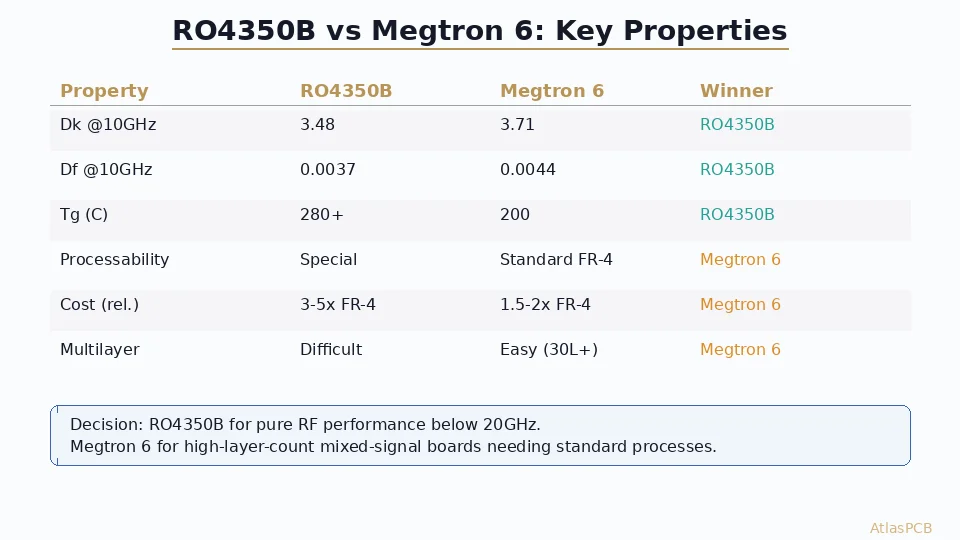
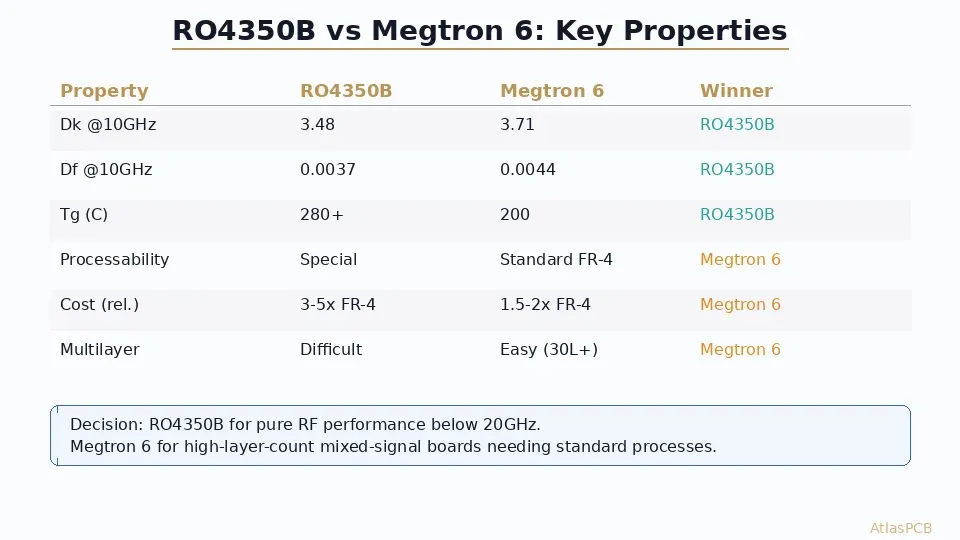
RO4350B wins on pure RF performance (lower Dk/Df) for applications below 20 GHz, while Megtron 6 wins on processability, cost, and multilayer capability for mixed-signal boards above 12 layers.
30-Second Decision
| Parameter | RO4350B | Megtron 6 | Winner |
|---|---|---|---|
| Dk @10 GHz | 3.48 | 3.71 | RO4350B |
| Df @10 GHz | 0.0037 | 0.0044 | RO4350B |
| Tg | 280C+ | 200C | RO4350B |
| CTE (z-axis) | 32 ppm/C | 45 ppm/C | RO4350B |
| Standard process compatible | Mostly | Fully | Megtron 6 |
| Max practical layer count | 8-10L | 30L+ | Megtron 6 |
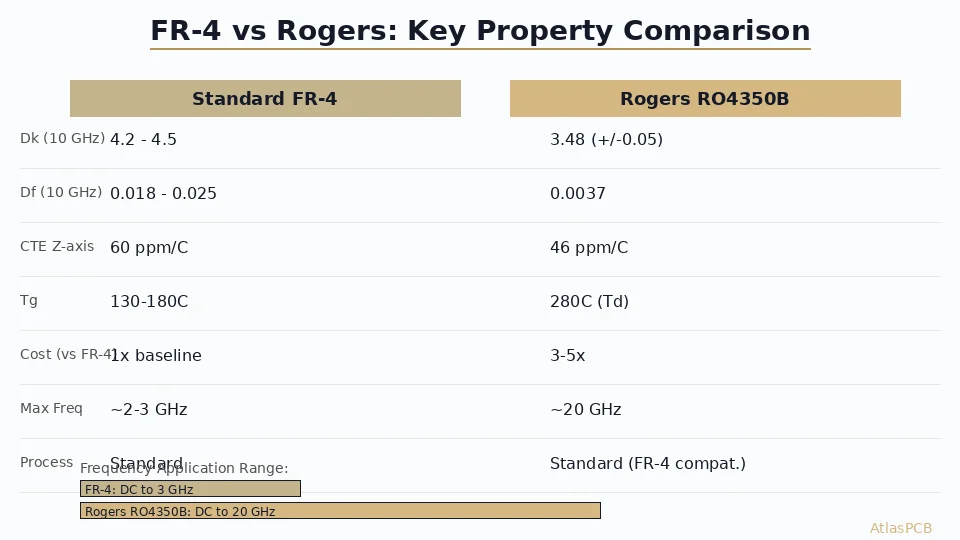
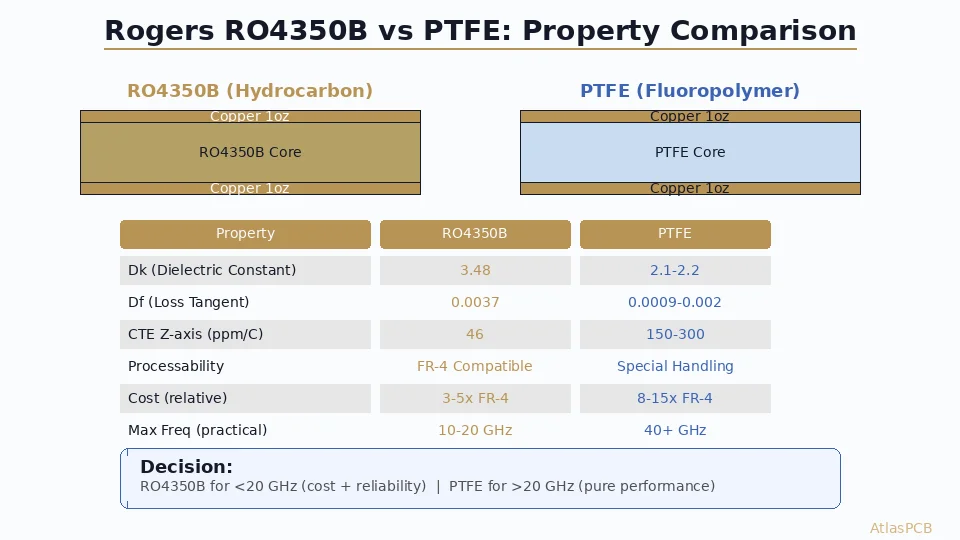
| Cost vs FR-4 | 3-5x | 1.5-2x | Megtron 6 |
| Lead time | 3-4 weeks | 2-3 weeks | Megtron 6 |
Bottom line: If your design is a dedicated RF front-end (antenna feed, LNA, filter) at 2-20 GHz with fewer than 10 layers, choose RO4350B. If you need a high-layer-count mixed-signal board with both high-speed digital (PCIe Gen5, 112G SerDes) and moderate RF performance, choose Megtron 6.
Electrical Performance: The Numbers That Matter
Dielectric Constant (Dk) Stability
RO4350B maintains Dk within +/-0.05 from 1 to 40 GHz. Megtron 6 shows more variation above 20 GHz, with Dk drift of +/-0.08. For impedance-controlled designs where tight tolerance matters (antenna matching networks, filter tuning), this stability directly affects yield.
Practical impact: A 50-ohm microstrip on RO4350B stays within +/-2 ohms across a 10 GHz bandwidth. The same trace on Megtron 6 may vary +/-4 ohms — acceptable for digital, problematic for RF.
Loss Tangent (Df) and Insertion Loss
At 10 GHz over a 100mm trace:
- RO4350B: 0.28 dB insertion loss
- Megtron 6: 0.34 dB insertion loss
- Standard FR-4 (Dk ~4.4, Df ~0.02): 1.5 dB insertion loss
The 0.06 dB difference between RO4350B and Megtron 6 becomes significant in:
- Phased array feeds with 16+ elements (cumulative loss budget)
- Multi-stage filter designs where every 0.1 dB matters
- Long backplane channels above 25 Gbps NRZ
For PCIe Gen5 (32 GT/s) over 200mm, both materials deliver adequate eye opening. The difference only surfaces at 112G PAM4 channel lengths above 150mm.
Fabrication and Processability
This is where Megtron 6 pulls ahead decisively.
Drilling
| Parameter | RO4350B | Megtron 6 |
|---|---|---|
| Mechanical drill min | 0.2mm (standard) | 0.15mm |
| Laser drill compatible | Yes (with tuning) | Yes (standard params) |
| Drill wear rate | Higher (ceramic filler) | Normal |
| Hole wall quality | Good (needs deburr) | Excellent |
RO4350B contains ceramic filler that accelerates drill bit wear. Production runs above 500 panels require more frequent bit changes, adding 5-10% to drilling cost.
Lamination
RO4350B requires:
- Specific bonding films (RO4450F or low-flow prepregs)
- Tighter temperature ramps (2C/min vs 3-4C/min standard)
- Not all fab shops have qualified RO4350B processes
Megtron 6 laminates with standard FR-4 prepregs and press cycles. Any shop running high-Tg FR-4 can process Megtron 6 without qualification.
RF PCB EXPERTISE
Not Sure Which Material Fits Your Design?
Our engineers work with both RO4350B and Megtron 6 daily. Upload your stackup for a material recommendation based on your actual frequency plan.
Get Material Recommendation ›
Hybrid Stackup: Using Both Materials Together
For complex systems (phased array radar, 5G base station), the optimal approach is often a hybrid stackup:
- RF layers (antenna/feed): RO4350B cores for antenna elements and RF signal routing
- Digital layers (FPGA, SerDes): Megtron 6 for high-speed digital interconnects
- Power layers: Standard high-Tg FR-4 (cost optimization)
Hybrid stackup example (10-layer):
L1  — RO4350B — Antenna/RF signals
L2  — GND (reference)
L3  — Megtron 6 — High-speed digital
L4  — GND
L5  — FR-4 — Power
L6  — FR-4 — Power
L7  — GND
L8  — Megtron 6 — High-speed digital
L9  — GND (reference)
L10 — RO4350B — RF signals
Challenges of hybrid:
- CTE mismatch between materials creates stress during thermal cycling
- Requires qualification of bonding film between dissimilar materials
- Limited to shops experienced with mixed-dielectric builds
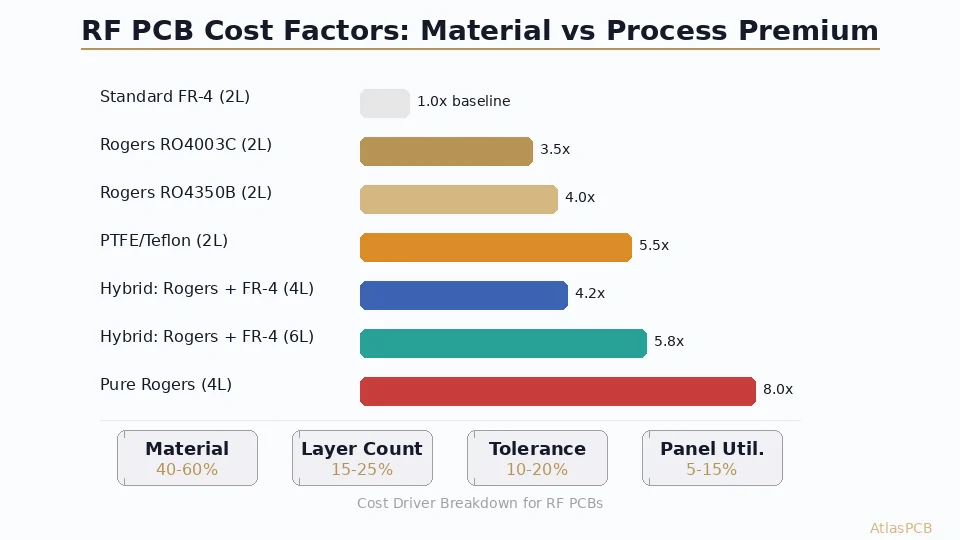
- Add 20-30% to cost vs single-material stackup
AtlasPCB regularly fabricates hybrid Rogers/FR-4 stackups with controlled CTE transitions.
MIXED-DIELECTRIC BUILDS
Hybrid Stackup? We Build Them Weekly.
Rogers + Megtron + FR-4 in a single board. Our lamination team has qualified 40+ hybrid material combinations.
View RF Capabilities ›Application Decision Matrix
| Application | Recommended | Reason |
|---|---|---|
| 77 GHz automotive radar | RO4350B (or RO3003) | Loss budget too tight for Megtron 6 |
| 5G sub-6 GHz massive MIMO | Megtron 6 | 20+ layers, standard processing, adequate loss |
| 28 GHz mmWave small cell | RO4350B (RF) + Megtron 6 (digital) | Hybrid approach |
| 400G switch/router backplane | Megtron 6 (or Megtron 7) | Layer count > 20, standard flow |
| Satellite L/S band transponder | RO4350B | Thermal reliability, low outgassing |
| PCIe Gen5 server board | Megtron 6 | Cost-effective, 16-24 layers |
| Phased array antenna element | RO4350B | Dk stability for beam steering accuracy |
| Test & measurement (VNA cal board) | RO4350B | Tightest Dk tolerance available |
PROTOTYPE FAST-TRACK
Rogers and Megtron In Stock
We stock RO4350B (20/30/60mil) and Megtron 6 cores. Prototype in 7-10 days for RF boards.
Upload Gerber Files ›Cost Comparison: Real-World Pricing
For a typical 6-layer, 100x100mm, 10-piece prototype run:
| Material | Panel Cost (approx.) | Lead Time |
|---|---|---|
| Standard FR-4 (Tg170) | $180-250 | 5-7 days |
| Megtron 6 | $320-450 | 10-14 days |
| RO4350B (all layers) | $650-900 | 14-21 days |
| Hybrid RO4350B + FR-4 | $450-650 | 12-18 days |
Volume pricing at 1000 pcs (same board):
- Standard FR-4: $8-12/board
- Megtron 6: $14-22/board
- RO4350B: $28-45/board
The 2-3x premium for Rogers only makes sense when electrical performance requirements genuinely demand it. Many designers over-specify material — using RO4350B where Megtron 6 suffices wastes 40-60% of material budget.
Standards and Specifications
| Standard | Relevance |
|---|---|
| IPC-4103 | Specification for Rogers-type materials (thermoset microwave) |
| IPC-4101/126 | Megtron 6 equivalent high-speed digital laminate |
| IPC-6012ES | Space/military addendum (relevant for RO4350B applications) |
| MIL-PRF-31032 | Qualified product list — check if your Rogers variant is listed |
ATLASPCB
Ready to Compare Quotes?
Upload your design — we quote both RO4350B and Megtron 6 options so you can compare cost vs performance with real numbers.
Get Dual-Material Quote ›
Related Reading:
About AtlasPCB — We specialize in complex PCB manufacturing for HDI, RF, and high-reliability applications. Explore our RF and high-frequency PCB services, Rogers RO4350B PCB manufacturing, or get an Megtron 6 & 7 low-loss PCB manufacturing . Every order includes free engineering review. Get your quote.
Reviewed by AtlasPCB Engineering Team — IPC-certified manufacturing specialists with 15+ years of production experience in HDI, RF, and high-reliability PCB fabrication. Content based on factory floor data and real customer design reviews.
Frequently Asked Questions
Can I use Megtron 6 instead of Rogers for 5G mmWave designs?
Is RO4350B compatible with standard FR-4 fabrication processes?
What is the cost difference between RO4350B and Megtron 6?
Which material has better thermal reliability for automotive radar?
- pcb-materials
- rf-pcb
- high-frequency
- rogers
- megtron