· David Okafor · Engineering · 11 min read
PCBWay vs JLCPCB
PCBWay or JLCPCB? Compare pricing model, lead time, layer count, materials, assembly, and quality certs — plus when each one wins, and when a specialist beats both.
Quick Answer
JLCPCB usually wins on raw price for simple 1-4 layer boards and low-cost assembly at volume, with very fast standard lead times. PCBWay wins on capability breadth, material choice, layer count, and hands-on support. For complex, high-reliability, or exotic-material boards, a specialist fabricator with human engineering review is the better fit.
The Short Answer
PCBWay and JLCPCB are both excellent, high-volume prototype-and-production houses, and for most everyday PCB orders either one will serve you well. They are genuine competitors that have driven prototype pricing down and quality up across the whole industry. This comparison is written to be fair to both — we are not here to declare a single “winner,” because the right choice depends entirely on what you are building.
At a very high level: JLCPCB is the price and speed leader for simple, standardized boards and low-cost assembly at volume. PCBWay offers broader capability, a wider material catalog, and more hands-on human support and flexibility. Below we compare them head-to-head in both directions, explain when each one wins, and then — honestly — where a specialist fabricator like AtlasPCB fits for the complex, high-reliability work that neither budget house is optimized for.
COMPLEX BOARD? TALK TO AN ENGINEER
Get Instant Quote
HDI, Rogers/PTFE RF, rigid-flex, or Class 3? Upload your Gerbers and get a quote reviewed by a human engineer — with material availability and DFM feedback confirmed upfront.
Get Instant Quote ›
PCBWay vs JLCPCB: Head-to-Head Comparison Table
The table below summarizes the practical differences. These reflect each company’s general positioning and public capability statements as of 2026 — always confirm current specs with a live quote for your exact stackup, because both providers update their capabilities and pricing frequently.
| Parameter | JLCPCB | PCBWay | Notes |
|---|---|---|---|
| Pricing model | Automated, panel-shared instant pricing; very aggressive entry price | Instant pricing plus quote flexibility; competitive, sometimes slightly higher on bare board | JLCPCB optimized for cheapest standard board |
| Best price point | Simple 1-4 layer FR-4, low-cost assembly at volume | Broader mix, complex boards, small-to-mid production | Gap narrows as complexity rises |
| Minimum order | 1-piece prototype (typically sold in small multiples) | 1-piece prototype | Both effectively low/1-piece MOQ |
| Standard lead time | Among the fastest for 2-layer (often 24-48h build) | Fast on standard; very flexible on rush requests | JLCPCB edges raw speed on standard boards |
| Layer count | Strong on low-to-mid; expanded into higher counts | Broader published high-layer-count range | Verify exact count when high |
| HDI / microvias | Available, growing; core strength is standard FR-4 | Broader advanced HDI and via structures | Confirm sequential-lamination steps |
| Materials | Mostly FR-4 tiers; some advanced/RF options | Wider catalog incl. several Rogers laminates, more specialty | PCBWay broader material choice |
| Rigid-flex / flex | Available | Broader rigid-flex offering | Class 3 rigid-flex: verify carefully |
| Assembly (PCBA) | Economy + standard SMT; huge in-house parts library, low cost at volume | Full turnkey assembly; strong support and flexibility | JLCPCB cheapest for volume SMT; PCBWay flexible |
| Quality / certs | ISO 9001, UL, RoHS; IPC standards on capable lines | ISO 9001, UL, RoHS, IATF; IPC Class 2/3 on capable lines | Confirm Class 3 + CoC per lot |
| Support model | Highly automated, ticket-based | More hands-on, responsive human support | PCBWay more flexible on edge cases |
| Best for | Cheapest fast standard boards + volume assembly | Broader capability, materials, and support | See “when each wins” below |
SPEC IT ONCE, QUOTE IT RIGHT
Get Instant Quote
Compare your board across suppliers with a spec sheet an engineer has reviewed. We quote FR-4, Rogers, HDI, and rigid-flex with lead time and CoC confirmed.
Get Instant Quote ›PCBWay vs JLCPCB: The Case for PCBWay
Looking at the matchup from the PCBWay side first, PCBWay’s core strength is breadth and flexibility. If your project lives even slightly outside the “standard 2-layer FR-4” lane, PCBWay tends to accommodate it more comfortably.
Wider material and process catalog. PCBWay publishes support for a broader range of laminates — including several Rogers high-frequency materials — plus more specialty finishes, thicker copper options, and a wide rigid-flex range. If your design needs a specific RF laminate or an unusual stackup, you are more likely to find it available without a special negotiation.
More layers and more complex builds. PCBWay’s published high-layer-count range and advanced via structures (blind/buried, some HDI) make it a natural fit for denser designs than a purely cost-optimized service targets.
Human, responsive support. This is the difference engineers notice most. PCBWay’s support model leans toward talking to a person who can flex on edge cases — an unusual panelization, a tight ship date, a material substitution. When your board is non-trivial, that responsiveness reduces friction.
A large community and prototyping ecosystem. PCBWay has invested heavily in community projects, sponsorships, and a shared-project marketplace, which many hardware developers value for visibility and collaboration.
The trade-off is that for the simplest, highest-volume standard boards, PCBWay’s bare-board price is often a little above JLCPCB’s rock-bottom entry pricing. If you are ordering ten 2-layer boards and price is the only variable, that difference is real — though usually small in absolute terms.
JLCPCB vs PCBWay: The Case for JLCPCB
Turning the comparison around, JLCPCB’s whole model is built around doing one thing extremely well: producing standard boards fast and cheap, at scale.
Lowest entry price on standard boards. JLCPCB’s panel-shared, heavily automated production is arguably the industry benchmark for cheapest simple-board pricing. For 1-2 layer and standard 4-layer FR-4 prototypes, its instant price is very hard to beat.
Blazing standard lead times. For a standard 2-layer board, JLCPCB routinely completes fabrication in roughly 24-48 hours before shipping. If you need iteration speed on a simple design, that cadence is excellent.
Low-cost, high-throughput assembly. JLCPCB’s assembly service, backed by an enormous in-house parts library, is one of the most cost-effective ways to get populated boards — especially at volume, and especially when you can design around parts already stocked. For cost-sensitive consumer or maker-adjacent production runs, this is a major advantage.
Integrated ecosystem. Tight integration between the PCB service, parts library, and assembly flow makes the “board plus components” path smooth for standard designs.
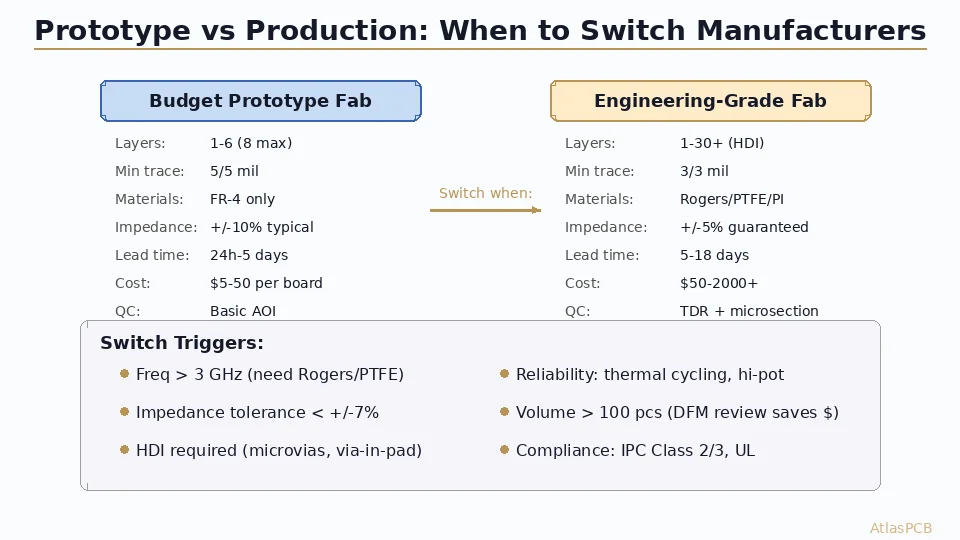
The trade-off is the mirror image of PCBWay’s strength: the automated model is optimized for the standard case. As soon as your board needs something non-standard — an exotic material, an aggressive HDI stackup, Class 3 documentation with per-lot CoC, or a design that genuinely needs a human to look at it — you are pushing against the grain of a system built for throughput, not bespoke engineering.
When Each One Wins
Rather than a blanket verdict, match the provider to the job:
Choose JLCPCB when:
- Your board is a simple, standard 1-4 layer FR-4 design.
- Price per board is the dominant constraint.
- You need the fastest possible turnaround on a standard prototype.
- You want low-cost SMT assembly at volume and can design around stocked parts.
- You are iterating rapidly on hobby, maker, or cost-sensitive consumer hardware.
Choose PCBWay when:
- Your design needs materials or processes beyond basic FR-4 (Rogers, thick copper, specialty finishes).
- You need higher layer counts, advanced vias, or rigid-flex.
- You value responsive human support and flexibility on non-standard requests.
- You are running small-to-medium production of varied or moderately complex boards.
- You want a broader single-vendor capability envelope so you do not have to re-source as complexity grows.
Both are legitimately good at what they target, and for a large share of everyday PCB work either will deliver a solid board at a fair price. The honest failure mode is not “picking the wrong one of these two” — it is using a volume-standard house for a board that actually needs specialist engineering.
NOT SURE WHICH LANE YOU'RE IN?
Get Instant Quote
Send us your stackup. If a standard house is the right call, we will tell you. If your board needs specialist processes, we will show you exactly why — with DFM review included.
Get Instant Quote ›The Third Option: When Complex, High-Reliability Boards Need a Specialist
Here is the part most comparison articles skip. PCBWay and JLCPCB are both built primarily around a fast, automated, self-service model — which is exactly why they are so good at prototypes and standard production. But there is a class of board where that model works against you, and where a specialist fabricator earns its place:
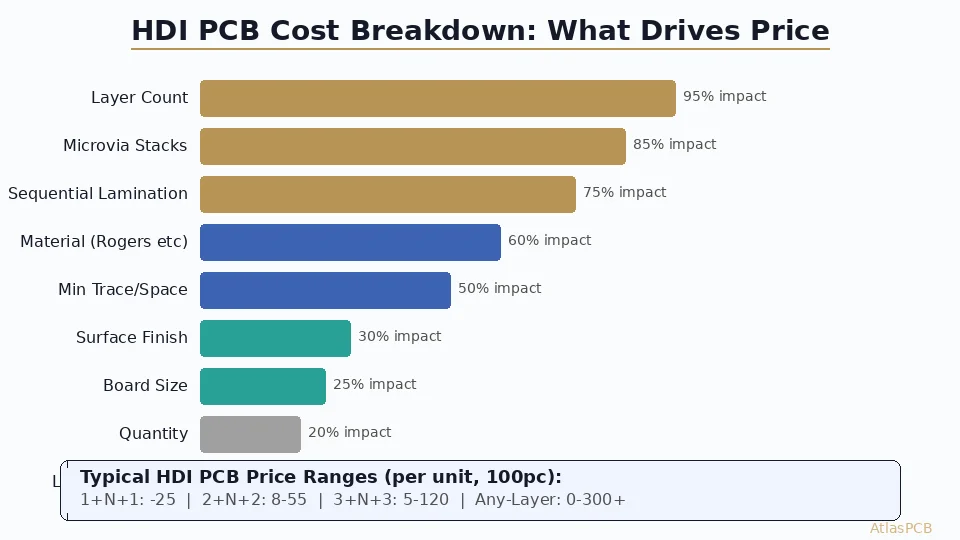
- HDI with 3+ sequential lamination steps — any-layer or staggered/stacked microvia stackups where via registration and lamination sequencing must be engineered, not queued. (Design references: IPC-2226 for HDI, IPC-2221 for generic design.)
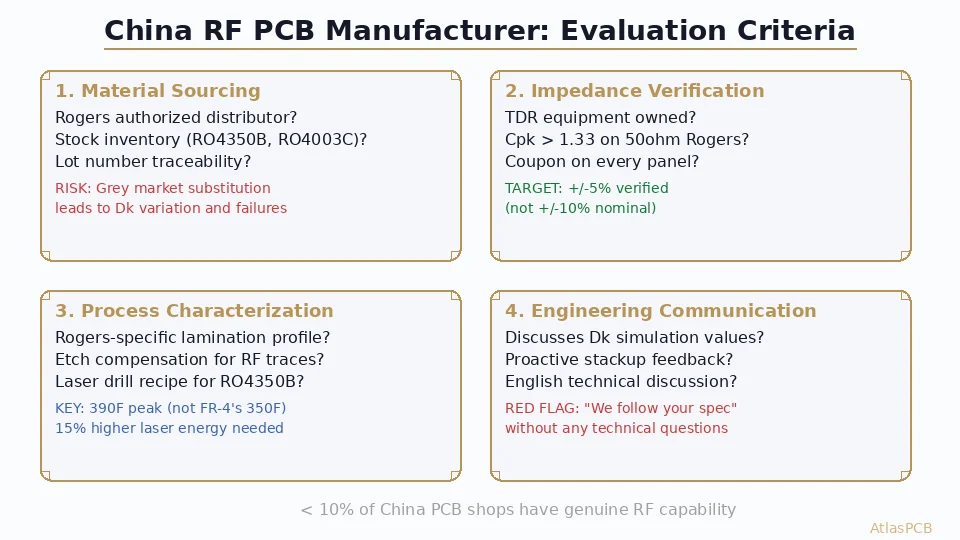
- Rogers / PTFE RF boards with tight impedance targets, where laminate handling, bonding, and controlled-impedance verification (per IPC-2141 transmission-line design) determine whether the board meets its loss budget.
- Rigid-flex built to IPC Class 3, where bend-radius, coverlay, and Class 3 acceptance criteria carry real reliability consequences.
- Tight-tolerance controlled-impedance stackups, where +/-5% (or tighter) impedance and TDR verification per lot matter.
- Any order that requires a material Certificate of Conformance and full traceability on every panel — common in aerospace, medical, and automotive supply chains.
For work like this, the value is not a cheaper sticker price — it is human engineering review before the board is built, material CoC on every order, and full traceability, which together reduce the risk of an expensive respin. That is the lane AtlasPCB is built for.
A few honest facts about where we fit: AtlasPCB has manufactured for 2,000,000+ customers across 60 countries since 2006, with 1,200+ engineers, 50+ certified factories, 99% on-time delivery, and 24/7 production. We build to IPC Class 2 and Class 3, hold ISO 9001:2015, IATF 16949, UL, and RoHS, support a 1-piece MOQ, and provide material CoC on every order. None of that makes us the right call for a $5 two-layer breakout board — for that, the volume houses above are genuinely excellent and you should use them. It makes us the right call when a fabrication mistake on a complex board is expensive, and you want an engineer to catch it first.
If your project sits in that complex/high-reliability category, these are the relevant starting points:
- HDI PCB manufacturing — sequential-lamination, microvia, any-layer stackups with engineering review.
- Rogers PCB fabrication — RF/PTFE laminates with controlled impedance and material CoC.
- Get an engineer-reviewed quote — upload Gerbers and stackup; we confirm capability, material, lead time, and DFM feedback before you commit.
Assembly (PCBA): A Closer Look
Because assembly is often the real cost driver, it deserves its own note. JLCPCB’s economy assembly is exceptionally cheap for standard SMT when you design around its stocked parts library — for cost-sensitive builds that is a strong reason to keep the whole job under one roof. PCBWay’s turnkey assembly is more flexible on sourcing, unusual components, and mixed through-hole/SMT jobs, with more hands-on coordination.
For high-reliability assembly — Class 3 workmanship, conformal coating with documentation, full AOI/X-ray traceability, and CoC — the same principle from the fabrication section applies: verify that the standard service tier actually delivers the documentation your program requires, and if it does not, use a fabricator whose assembly line is built for that standard from the start.
Applications: Which Route Fits Which Project
| Project type | Best starting point | Why |
|---|---|---|
| Hobby / maker 2-layer board | JLCPCB | Cheapest, fastest standard boards |
| Cost-sensitive consumer volume | JLCPCB | Lowest assembly cost at volume |
| Moderately complex product (4-8 layer, some RF) | PCBWay | Broader materials + flexible support |
| Small-batch varied production | PCBWay | Capability breadth, human support |
| 3+ step HDI / any-layer | Specialist (AtlasPCB) | Engineered lamination + review |
| Rogers/PTFE RF with tight impedance | Specialist (AtlasPCB) | Material handling + CoC + TDR |
| Rigid-flex Class 3 | Specialist (AtlasPCB) | Class 3 acceptance + traceability |
| Aerospace/medical/automotive | Specialist (AtlasPCB) | IATF 16949, Class 3, per-lot CoC |
Summary: Making the Call
The PCBWay vs JLCPCB decision is not a war with a single winner — it is a fit question:
- Simple, standard, price-first, fast: JLCPCB is hard to beat, especially with volume assembly.
- Broader capability, more materials, flexible human support: PCBWay is the stronger all-rounder.
- Complex, high-reliability, exotic-material, documentation-heavy: a specialist with engineering review, material CoC, and full traceability protects you from expensive respins — that is where AtlasPCB fits.
Pick the tool that matches the job. For the majority of standard prototypes, the two houses compared here will serve you well and we would happily point you to them. For the boards where getting it wrong is costly, talk to an engineer before you build.
ATLASPCB
Get Instant Quote
Upload your Gerbers and stackup. We quote FR-4, Rogers, HDI, and rigid-flex with material availability, lead time, and CoC confirmed — reviewed by a human engineer, not just an algorithm.
Get Instant Quote ›
Reviewed by AtlasPCB Engineering Team — 15+ years in advanced PCB fabrication for HDI, RF/Rogers, and rigid-flex applications. We compare providers honestly because trust is worth more than a single order.
Related Reading:
About AtlasPCB — We specialize in complex PCB manufacturing for HDI, RF, and high-reliability applications. Explore our HDI PCB manufacturing capabilities, RF and high-frequency PCB services, or get an Rogers RO4350B PCB manufacturing . Every order includes free engineering review. Get your quote.
Reviewed by AtlasPCB Engineering Team — IPC-certified manufacturing specialists with 15+ years of production experience in HDI, RF, and high-reliability PCB fabrication. Content based on factory floor data and real customer design reviews.
Frequently Asked Questions
Is JLCPCB or PCBWay cheaper?
Which has faster lead time, JLCPCB or PCBWay?
Can JLCPCB and PCBWay do HDI and Rogers boards?
Are PCBWay and JLCPCB good for production, not just prototypes?
When should I NOT use JLCPCB or PCBWay?
- PCBWay vs JLCPCB
- JLCPCB vs PCBWay
- PCB manufacturer comparison
- PCB prototype
- PCB assembly
- HDI PCB
- Rogers PCB