· Marcus Lin · Engineering · 4 min read
PCB Materials Guide
Compare common PCB substrate materials — FR-4, CEM-1, CEM-3, Rogers, polyimide, and ceramic. Understand their properties, costs, and best applications for your design.

Quick Answer
PCB substrate materials include FR-4 (most common, suitable for general applications), Rogers (high-frequency RF), polyimide (flex circuits, high temperature), CEM-1/CEM-3 (low-cost single-layer), and ceramic (extreme environments). Material selection depends on frequency, temperature, flexibility, and cost requirements.
The substrate material determines a PCB’s electrical performance, thermal behavior, mechanical strength, and cost. Choosing the right material is one of the most impactful decisions in board design. This guide compares the most common PCB materials.
FR-4: The Industry Standard
FR-4 (Flame Retardant 4) is a glass-reinforced epoxy laminate. It accounts for over 90% of all PCBs manufactured worldwide.
Properties
| Parameter | Value |
|---|---|
| Dielectric constant (Dk) | 4.2-4.8 at 1 MHz |
| Dissipation factor (Df) | 0.015-0.025 |
| Glass transition temp (Tg) | 130-180°C |
| Thermal conductivity | 0.25-0.3 W/m·K |
| CTE (Z-axis) | 40-70 ppm/°C (below Tg) |
| Moisture absorption | 0.1-0.15% |
| Peel strength | 1.0-1.4 N/mm |
| UL flammability | V-0 |
FR-4 Grades
Standard FR-4 (Tg 130-140°C):
- Cheapest option
- Suitable for single or double reflow with SnPb solder
- Not recommended for lead-free assembly (peak 260°C)
Mid-Tg FR-4 (Tg 150-160°C):
- Good balance of cost and performance
- Suitable for most lead-free processes
- Recommended for 4+ layer boards
High-Tg FR-4 (Tg 170-180°C):
- Best FR-4 grade for reliability
- Required for thick boards (>2.0mm) to prevent Z-axis expansion damage
- Automotive and industrial applications
- 10-20% cost premium over standard
Halogen-Free FR-4:
- Meets environmental regulations (IEC 61249-2-21)
- No bromine or chlorine flame retardants
- Required for EU market compliance in many product categories
- 5-15% premium
When to Use FR-4
- General consumer and industrial electronics
- Operating frequencies below 1-2 GHz
- Standard temperature range (-40 to +125°C)
- Cost-sensitive applications
CEM-1 and CEM-3
CEM-1 (Composite Epoxy Material)
- Paper core with glass surface layers
- Single-sided boards only (cannot be plated through)
- Cheapest PCB material available
- Used for very simple, cost-driven products (calculators, basic LED)
CEM-3
- Glass fiber non-woven core with glass surface layers
- Can be drilled and plated (supports double-sided boards)
- Smoother drilling than FR-4 (less glass fiber pull-out)
- 10-20% cheaper than FR-4
- Popular in Asia for consumer electronics
| Feature | CEM-1 | CEM-3 | FR-4 |
|---|---|---|---|
| Layers | 1 only | 1-2 | 1-30+ |
| PTH capable | No | Yes | Yes |
| Dk | 4.5-5.5 | 4.5-5.0 | 4.2-4.8 |
| Mechanical strength | Low | Medium | High |
| Cost | Lowest | Low | Standard |

Rogers: High-Frequency Laminates
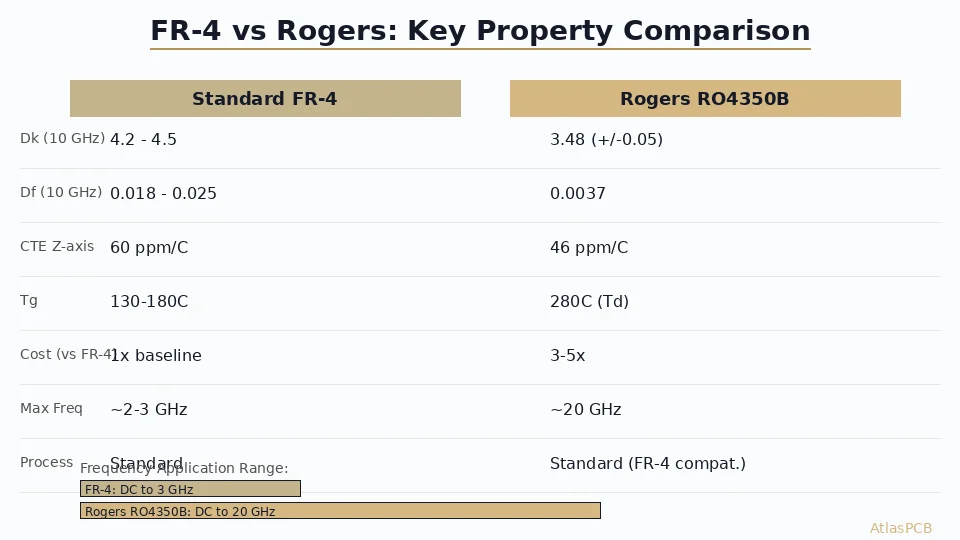
Rogers Corporation produces specialty laminates designed for RF, microwave, and high-speed digital applications where FR-4 falls short.
Popular Rogers Materials
RO4003C:
- Dk: 3.38 +/-0.05 (tight tolerance)
- Df: 0.0027 at 10 GHz
- Tg: >280°C
- Processable with standard FR-4 equipment
- Most popular Rogers material for commercial RF
- Cost: 3-5x FR-4
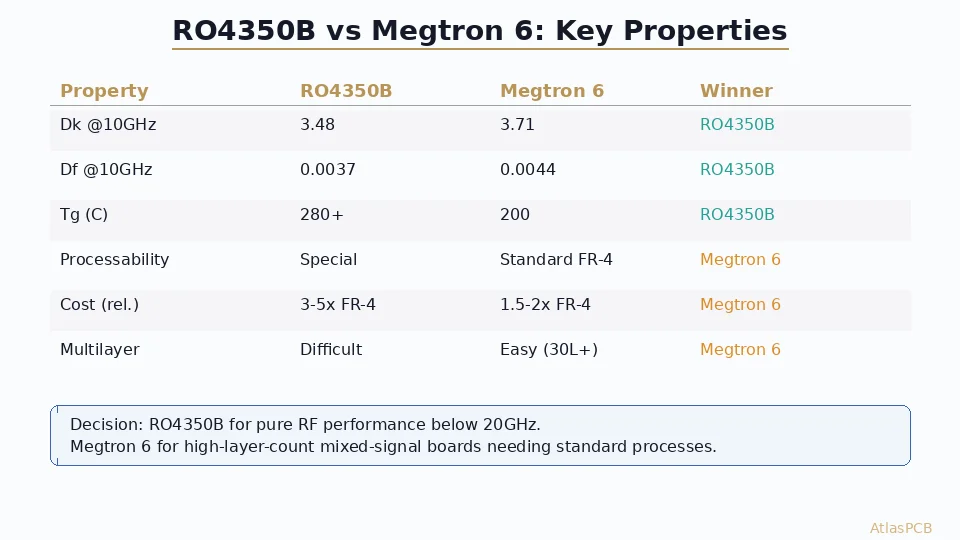
RO4350B:
- Dk: 3.48 +/-0.05
- Df: 0.0037 at 10 GHz
- UL 94 V-0 rated
- Good for hybrid builds (Rogers + FR-4 stackup)
- Cost: 3-5x FR-4
RO3003 (PTFE-based):
- Dk: 3.00 +/-0.04
- Df: 0.0013 at 10 GHz
- Excellent for high-frequency (up to 40 GHz)
- Difficult to process (soft PTFE material)
- Cost: 8-15x FR-4
RT/duroid 5880:
- Dk: 2.20 +/-0.02
- Df: 0.0009 at 10 GHz
- Lowest loss commercially available
- Satellite, radar, aerospace
- Cost: 10-20x FR-4
When to Use Rogers
- Operating frequency above 2-3 GHz
- Low-loss requirements (radar, satellite, 5G mmWave)
- Tight Dk tolerance for impedance-critical designs
- Phase-sensitive circuits (antenna arrays, beamforming)
Polyimide (Kapton)
Polyimide is the standard substrate for flexible and high-temperature PCBs.
Properties
| Parameter | Value |
|---|---|
| Dk | 3.2-3.5 at 1 MHz |
| Df | 0.002-0.003 |
| Tg | >300°C |
| Continuous operating temp | -269°C to +400°C |
| CTE | 12-20 ppm/°C |
| Moisture absorption | 2.5-3.0% (higher than FR-4) |
| Flexibility | Excellent |
Applications
- Flexible PCBs (FPC) and rigid-flex boards
- High-temperature environments (aerospace, automotive under-hood, oil/gas downhole)
- Space applications (radiation tolerance)
- Dynamic flex applications (millions of bend cycles)
Cost
5-10x FR-4 for rigid applications; standard for flex PCBs where no alternative exists.
Ceramic Substrates
Alumina (Al2O3)
- Dk: 9.0-10.0
- Df: 0.0001-0.0003
- Thermal conductivity: 20-30 W/m·K
- Extremely stable across frequency and temperature
- Used for: thick-film hybrid circuits, LED substrates, power modules
Aluminum Nitride (AlN)
- Thermal conductivity: 170-230 W/m·K
- Used for: high-power RF, laser diode carriers, power electronics
- Cost: 10-50x alumina
LTCC (Low Temperature Co-fired Ceramic)
- Multilayer ceramic construction
- Embedded passive components (resistors, capacitors, inductors)
- Hermetic packaging capability
- Used for: military, aerospace, medical implants
Hybrid/Mixed Material Stackups
Modern designs often combine materials in a single board:
- Rogers + FR-4: RF layers use Rogers; digital layers use FR-4. Reduces cost while maintaining RF performance.
- Polyimide + FR-4: Rigid-flex construction with polyimide flex sections and FR-4 rigid sections.
- Metal core + FR-4: Aluminum base with FR-4 circuit layers for LED and power applications.
Design Considerations for Hybrids
- CTE mismatch between materials can cause reliability issues
- Different Dk values affect impedance at material boundaries
- Not all manufacturers can process mixed-material stackups
- Cost is typically 2-3x a pure FR-4 equivalent
Material Selection Quick Guide
| Application | Recommended Material |
|---|---|
| Consumer electronics | Standard FR-4 |
| Industrial (lead-free) | Mid/High-Tg FR-4 |
| Automotive | High-Tg FR-4 or Polyimide |
| WiFi/Bluetooth (2.4-5.8 GHz) | FR-4 (careful design) or RO4003C |
| 5G Sub-6 GHz | RO4003C/RO4350B |
| 5G mmWave (24-40 GHz) | RO3003/RT5880 |
| Radar | Rogers PTFE series |
| Flex/Wearable | Polyimide |
| High-power LED | Aluminum MCPCB |
| Military/Aerospace | Polyimide, Rogers, or Ceramic |
Conclusion
FR-4 handles the vast majority of PCB applications. Move to specialized materials only when electrical performance (high frequency, low loss), thermal requirements (extreme temperatures), or mechanical needs (flexibility) demand it. Always verify material availability and processing capabilities with your manufacturer before committing to a non-standard material, as lead times and minimum order quantities can be significant.
Further Reading
[Rogers 4350B vs FR4: When to Upgrade Your PCB Material]/blog/rogers-4350b-vs-fr4/)
[High-Multilayer FR4 vs Standard FR4: When to Upgrade Material Grade]/blog/high-multilayer-fr4-vs-standard-fr4/)
[RF PCB Materials Comparison: FR4 vs Rogers vs Taconic vs Isola]/blog/rf-pcb-materials-comparison/)
[Rigid-Flex PCB Design: Stackup, Bend Rules, and Manufacturing Guidelines]/blog/rigid-flex-pcb-design/)
[HDI PCB Design Guide: Stackup Rules, Via Structures & DFM Checklist]/blog/hdi-pcb-design-guide/)
About AtlasPCB — We specialize in complex PCB manufacturing for HDI, RF, and high-reliability applications. Explore our RF and high-frequency PCB services, or get an Rogers RO4350B PCB manufacturing . Every order includes free engineering review. Get your quote.
Reviewed by AtlasPCB Engineering Team — IPC-certified manufacturing specialists with 15+ years of production experience in HDI, RF, and high-reliability PCB fabrication. Content based on factory floor data and real customer design reviews.
Frequently Asked Questions
What is the most common PCB material?
When should I use Rogers instead of FR-4?
What PCB material is best for flex circuits?
- pcb materials
- FR-4
- Rogers
- substrate