· AtlasPCB Engineering · Engineering · 10 min read
Multilayer PCB Cost Breakdown: How Layer Count, HDI, and Material Selection Affect Your Quote in 2026
A transparent pricing guide for multilayer PCBs from 4 to 30 layers. Covers the real cost drivers — layer count multipliers, HDI sequential lamination charges, material premiums, and volume pricing tiers — with actual price ranges from a China-based manufacturer perspective.
Quick Answer
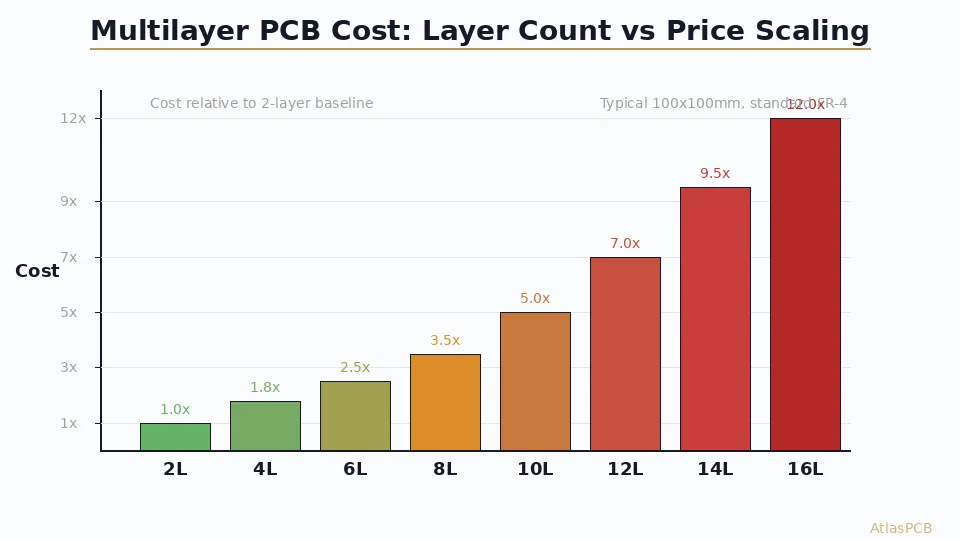
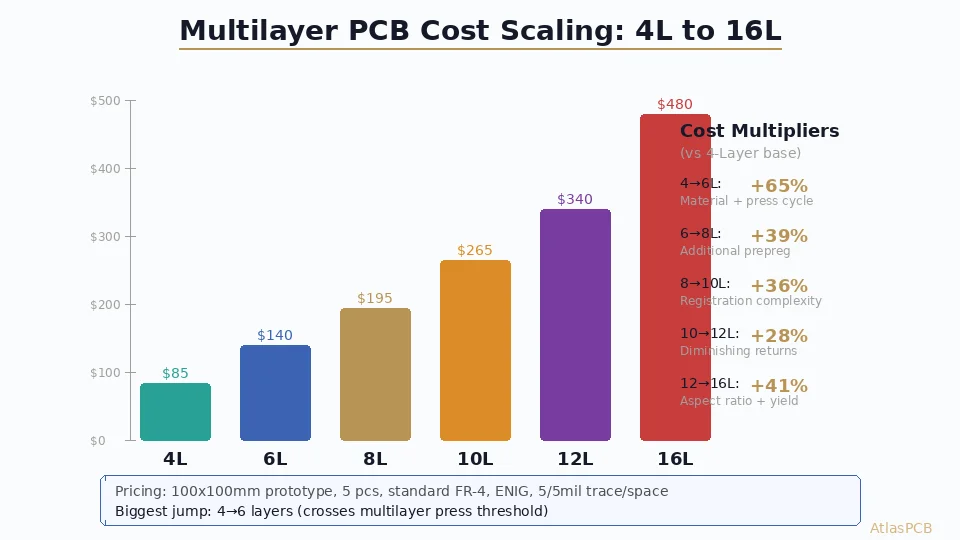
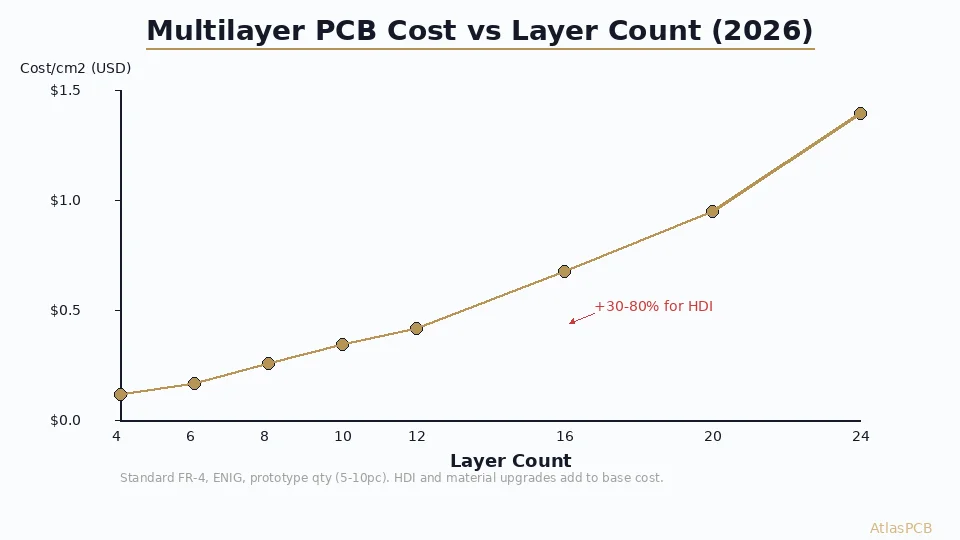
Multilayer PCB cost scales roughly 1.5-2x per doubling of layer count: a standard 4-layer FR-4 board costs $0.08-0.15/cm2 at prototype quantities, 8-layer costs $0.18-0.35/cm2, 12-layer costs $0.30-0.55/cm2, and 16+ layers cost $0.50-1.20/cm2. HDI construction adds 30-80% on top of the base multilayer cost depending on the buildup structure (1+N+1 vs 3+N+3). Material upgrades from FR-4 to Rogers or Megtron 6 add 80-200% to the affected layers.
The Reality of Multilayer PCB Pricing in 2026
PCB pricing is not a mystery — it follows predictable engineering economics. Every fabricator uses roughly the same materials and equipment, so cost differences come down to three factors: yield at a given complexity level, material purchasing power, and overhead structure. This guide breaks down exactly how layer count, HDI construction, and material selection drive your bill of materials line item for PCB fabrication.
All prices in this article reflect actual Q3 2026 pricing from our facility in China, shipping FOB Shenzhen. International shipping, import duties, and broker fees are excluded. All values are in USD.
Layer Count: The Primary Cost Driver
Why Each Layer Pair Costs More Than the Last
Multilayer PCB fabrication is fundamentally a lamination process — pressing layers of copper foil and dielectric together under heat and pressure. Each additional layer pair (two copper layers plus dielectric) adds cost through three mechanisms: material (copper foil and prepreg), processing (an additional imaging, etching, and AOI cycle for each layer pair), and yield loss (each additional layer is another opportunity for a defect that scraps the entire panel).
The yield factor is the non-obvious cost driver. A process with 99% yield per layer results in 96% overall yield for a 4-layer board (0.99^4) but only 88% for a 12-layer board (0.99^12) and 78% for a 24-layer board. That 18-point yield difference between 12 and 24 layers means the manufacturer must start more panels to deliver the same quantity — and those scrapped panels consumed real materials and machine time.
Actual Cost Ranges by Layer Count (Q3 2026)
| Layer Count | Cost per cm2 (Prototype, 5-10pc) | Cost per cm2 (Volume, 500pc) | Typical Use Case |
|---|---|---|---|
| 2-layer | $0.03-0.06 | $0.008-0.015 | Simple digital, LED boards |
| 4-layer | $0.08-0.15 | $0.025-0.045 | Most consumer electronics |
| 6-layer | $0.12-0.22 | $0.040-0.070 | IoT, WiFi modules |
| 8-layer | $0.18-0.35 | $0.060-0.100 | Networking, compute modules |
| 10-layer | $0.25-0.45 | $0.085-0.140 | Server boards, 5G radio |
| 12-layer | $0.30-0.55 | $0.110-0.180 | High-speed networking |
| 16-layer | $0.50-0.85 | $0.170-0.280 | Datacenter switches |
| 20-layer | $0.70-1.20 | $0.250-0.400 | AI accelerators |
| 24-layer | $1.00-1.80 | $0.380-0.600 | Advanced compute, backplanes |
| 30-layer | $1.50-2.80 | $0.550-0.900 | High-end servers, aerospace |
These ranges assume standard FR-4 (Tg 150-170C), 1oz copper, ENIG finish, and standard tolerances. Each specialization layer (controlled impedance, blind/buried vias, heavy copper) adds to these base costs.
INSTANT PRICING
Get Your Multilayer PCB Quote in 4 Hours
Upload your Gerber files for an exact quote. We price 4 to 30 layers with full stackup specification.
Upload Gerbers ›
HDI Construction: The Sequential Lamination Premium
Understanding the HDI Cost Multiplier
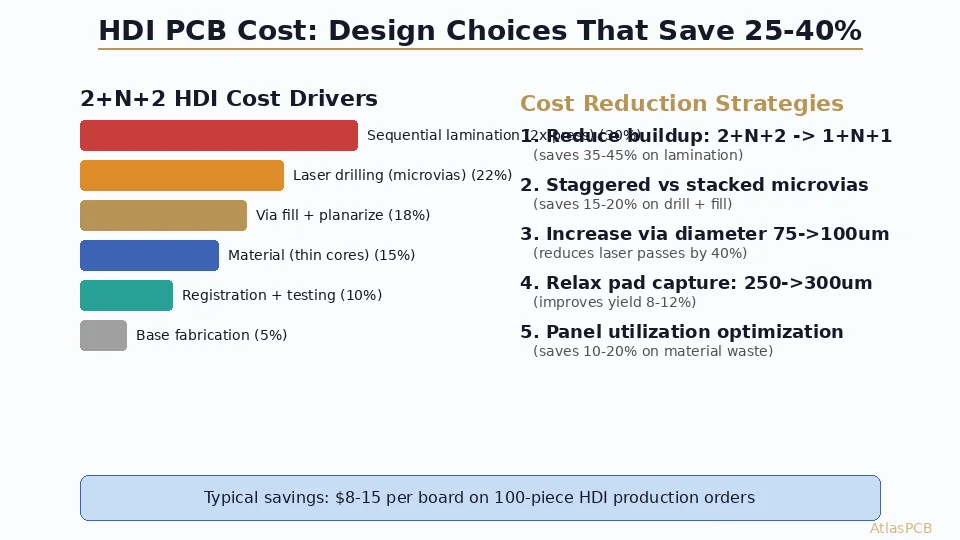
HDI (High Density Interconnect) PCBs use laser-drilled microvias and sequential lamination to achieve higher routing density in fewer layers. The tradeoff is straightforward: an HDI board costs more per layer but may need fewer total layers than a conventional through-hole design to route the same complexity.
The cost structure of HDI fabrication at our facility breaks down into:
Laser drilling: $0.003-0.008 per microvia depending on diameter and depth. A typical 0.5mm-pitch BGA with 400 balls requires approximately 200 microvias per layer. At $0.005/via, that is $1.00 per panel per microvia layer — negligible in isolation but significant when multiplied across 4-6 microvia layers on a 3+N+3 HDI board.
Sequential lamination: Each buildup stage (one microvia layer on each side of the core) requires a separate press cycle. Standard lamination costs $20-35 per panel; each sequential cycle adds $15-30. A 3+N+3 structure requires 3 additional press cycles beyond the standard multilayer process, adding $45-90 per panel in pressing costs alone.
Yield impact: Sequential lamination compounds yield risk. If the core lamination achieves 97% yield and each buildup stage achieves 98% yield, a 3+N+3 structure has an overall yield of 0.97 x 0.98^3 = 91%. That 6-point yield loss compared to a standard multilayer represents real cost that gets distributed across delivered panels.
HDI Cost Premium by Structure
| HDI Structure | Cost Premium vs Standard Multilayer | When to Use |
|---|---|---|
| 1+N+1 (one buildup each side) | +30-40% | 0.5mm pitch BGA breakout |
| 2+N+2 | +45-60% | 0.4mm pitch BGA, moderate density |
| 3+N+3 | +60-80% | 0.3mm pitch, high-density mobile/AI |
| Any-Layer (ELIC) | +100-150% | 0.25mm pitch, maximum density |
| Stacked microvias | +15-25% additional | Multi-layer spanning connections |
When HDI Saves Money (Counter-intuitive Economics)
Despite the per-unit cost premium, HDI construction sometimes reduces total system cost. Consider this real scenario from a networking customer we fabricated for in Q2 2026:
Conventional approach: 16-layer through-hole board, 100x120mm, with fan-out routing from 0.8mm-pitch BGAs requiring layers 3-14 for signal routing. Standard FR-4, 4/4mil trace/space. Cost: $0.65/cm2 at 200-unit volume = $78/board.
HDI approach: 10-layer with 1+N+1 HDI structure, same board size. Microvias eliminated 4 layers of BGA breakout routing. Same area, fewer layers, but HDI premium. Cost: $0.52/cm2 at 200-unit volume = $62.40/board.
The HDI board saved $15.60 per unit (20%) despite using more expensive construction — because eliminating 6 layers worth of material and processing more than offset the sequential lamination premium. This crossover typically happens when the conventional design requires 14+ layers primarily for BGA breakout routing.
Material Selection: Where Cost Gets Serious
Standard FR-4 Variants and Their Price Points
Not all FR-4 is created equal. The “FR-4” designation covers a wide range of glass-epoxy laminates with different thermal and electrical properties. Here is what the material upgrade ladder looks like in terms of cost impact:
| Material | Tg (C) | Dk/Df (10GHz) | Cost vs Standard | Best Application |
|---|---|---|---|---|
| Standard FR-4 (Shengyi S1141) | 150 | 4.5/0.020 | Baseline | Consumer, IoT |
| Mid-Tg FR-4 (Shengyi S1150G) | 170 | 4.4/0.018 | +10-15% | Automotive, industrial |
| High-Tg FR-4 (Shengyi S1170) | 180 | 4.3/0.015 | +20-30% | Lead-free assembly, BGA |
| Low-loss FR-4 (Panasonic Megtron 4) | 200 | 3.9/0.007 | +60-80% | High-speed digital 25G+ |
| Very-low-loss (Panasonic Megtron 6) | 215 | 3.7/0.004 | +100-150% | 56-112G SerDes |
| Rogers RO4350B | 280+ | 3.48/0.0037 | +300-500% | RF/microwave above 5 GHz |
| Rogers RO3003 | 280+ | 3.0/0.0013 | +500-800% | mmWave above 30 GHz |
These multipliers apply to the affected layers only. A hybrid 8-layer board using Rogers on 2 layers and standard FR-4 on 6 layers costs approximately 80-120% more than all-FR-4, not 300-500% more.
Surface Finish Cost Impact
| Finish | Cost Premium (per cm2) | Shelf Life | Best For |
|---|---|---|---|
| HASL (Sn-Pb) | Baseline ($0) | 12 months | Low-cost, non-fine-pitch |
| Lead-free HASL | +$0.005 | 12 months | RoHS, standard pitch |
| OSP | +$0.003 | 3-6 months | Cost-sensitive, quick assembly |
| Immersion Tin | +$0.008 | 6 months | Press-fit connectors |
| Immersion Silver | +$0.010 | 6 months | RF boards (flat, low loss) |
| ENIG | +$0.020-0.035 | 12+ months | Fine-pitch BGA, wire bonding |
| Hard Gold (30u”) | +$0.080-0.150 | Indefinite | Edge connectors, high-cycle insertion |
COST OPTIMIZATION
Want to Reduce Your Multilayer PCB Cost?
Our engineers review your design and suggest cost-reduction opportunities — from layer count optimization to material substitution — without compromising performance.
Request Cost Review ›Volume Pricing: The Breakpoints That Matter
PCB pricing is heavily volume-dependent because fabrication has significant fixed costs (engineering, tooling, first-article inspection) that amortize across quantity. Understanding the pricing curve helps you plan procurement timing and order consolidation.
Typical Volume Pricing Curve (8-layer FR-4, 100x80mm, ENIG)
| Quantity | Unit Price | Price Driver |
|---|---|---|
| 1-5 pieces | $28-35 | Engineering + setup dominates |
| 10 pieces | $18-22 | Setup amortizing but still significant |
| 25 pieces | $14-17 | Material becoming primary cost |
| 50 pieces | $10-13 | Efficient panelization kicks in |
| 100 pieces | $7-9 | Full panel utilization |
| 500 pieces | $4.50-6 | Volume material pricing |
| 1000 pieces | $3.50-5 | Production efficiency maximized |
| 5000+ pieces | $2.50-3.50 | Negotiated material contracts |
The sharpest price drops happen between 5 and 50 units (60-70% cost reduction) because this is where fixed setup costs transition from dominant to negligible. After 500 units, further volume gains are incremental (material purchasing leverage and production line efficiency).
Cost-Saving Tips From Our Production Floor
Based on fabricating thousands of unique designs each month, here are the most impactful cost reduction strategies we recommend to customers:
Panelization efficiency matters enormously. A 50x80mm board fits 12 pieces per standard 18x24” panel. A 55x85mm board (just 10% larger) fits only 9 pieces per panel — a 25% reduction in panel utilization that directly increases unit cost. If you can trim 5mm from a board edge by optimizing component placement, the cost savings at volume are substantial.
Standard thicknesses avoid premiums. 1.0mm, 1.2mm, and 1.6mm thicknesses use stock material from our warehouse. Non-standard thicknesses (0.8mm, 2.0mm, 2.4mm) may require special material orders with 2-3 week lead times and minimum order charges.
Consolidate drill sizes. Each unique drill tool requires a tool change during drilling, adding cycle time. Boards with 15+ unique drill sizes cost more than equivalent boards with 8-10 sizes. If you have 0.3mm and 0.35mm vias that serve the same function, standardizing on one size saves tooling time.
Controlled Impedance: What It Actually Costs
Engineers often worry that specifying controlled impedance dramatically increases cost. The reality is more nuanced. Standard impedance control (+/-10% tolerance) on FR-4 adds approximately 5-10% to fabrication cost — primarily from test coupon fabrication and TDR measurement time. The test coupons consume a small amount of panel area (typically 15x100mm strips at panel edges), and measurement adds 10-15 minutes per panel.
Tight-tolerance impedance (+/-5%) adds somewhat more: 10-15% in additional cost because it requires etch compensation tuning (potentially running test panels first) and 100% TDR verification rather than statistical sampling. For impedance controlled PCBs requiring +/-5% or better, we recommend consolidating all impedance-critical traces onto 2-3 layers rather than distributing them across all layers — this reduces the number of test structures needed and simplifies verification.
Where impedance control becomes expensive is when it forces material changes. If your impedance target requires a dielectric thickness that standard FR-4 prepreg cannot provide, the manufacturer must substitute specialty material — and suddenly you are paying for Megtron or Rogers on that layer pair. Always verify impedance feasibility with your manufacturer’s available prepreg library before committing to a stackup.
HDI PCB MANUFACTURING
Complex Boards, Transparent Pricing
From 4-layer prototypes to 30-layer HDI production — we quote the full range. Upload your design for exact pricing with stackup details.
Get Exact Quote ›Making Your Budget Decision
The most cost-effective multilayer PCB is not the cheapest per unit — it is the one that meets your performance requirements without over-specifying materials, layers, or tolerances. Here is a practical framework:
Start with the minimum layer count that routes cleanly with your preferred trace/space rules. If 6 layers route at 4/4mil but 8 layers let you relax to 5/5mil, the 8-layer board at 5/5mil is often cheaper because the yield improvement from wider tolerances outweighs the additional layers.
Use hybrid materials strategically. A 10-layer board that needs Rogers on 2 RF layers costs 80-100% more than all-FR-4, but going all-Rogers on 10 layers costs 350-500% more. Put expensive material only where electrical performance demands it.
Plan for volume early. If you know production will exceed 500 pieces, invest in DFM optimization during the prototype phase. A $200 re-layout to improve panelization efficiency pays for itself at 100 units and saves thousands at production volume.
ATLASPCB
Ready to Get Your Multilayer Quote?
Upload Gerber files for instant pricing on any layer count, material, or HDI structure. We include stackup verification and DFM review with every quote.
Get Instant Quote ›
Reviewed by AtlasPCB Engineering Team — 15+ years in advanced PCB fabrication for RF, HDI, and rigid-flex applications.
Related Reading:
About AtlasPCB — We specialize in complex PCB manufacturing for HDI, RF, and high-reliability applications. Explore our HDI PCB manufacturing capabilities, impedance-controlled PCB manufacturing, or get an PCB prototype manufacturing from 1 piece . Every order includes free engineering review. Get your quote.
Reviewed by AtlasPCB Engineering Team — IPC-certified manufacturing specialists with 15+ years of production experience in HDI, RF, and high-reliability PCB fabrication. Content based on factory floor data and real customer design reviews.
Frequently Asked Questions
How much does a 4-layer PCB cost vs an 8-layer PCB?
What makes HDI PCBs more expensive than standard multilayer?
Is it cheaper to use more layers or finer traces?
How much does controlled impedance add to PCB cost?
What is the cheapest way to get a multilayer PCB prototype?
- multilayer PCB cost
- HDI PCB manufacturer
- PCB stackup design guide
- impedance controlled PCB manufacturer
- PCB prototype cost